

Naguib Mahfouz
Egypt
Patient and richly furnished, moving between a whole household's private thoughts: realist prose with the pacing and detail of a family chronicle.
Mahfouz worked for nearly four decades as a civil servant in the Egyptian Ministry of Culture and other government offices, writing fiction in the early mornings and evenings around a bureaucrat's schedule that he kept even after fame arrived. He grew up in the old Cairo neighborhood of Gamaliya, whose alleys, coffeehouses, and merchant families supplied the material for nearly everything he wrote.
The Cairo Trilogy (Palace Walk and its two sequels, published across 1956 and 1957) follows one merchant household through the political upheavals of the early twentieth century, and established him as the Arabic novel's central figure; he had already been experimenting for decades with historical allegory and social realism before it appeared. His 1988 Nobel Prize was the first awarded to a writer working in Arabic.
In 1994 an Islamist extremist stabbed him in the neck outside his Cairo home, condemning him for an earlier allegorical novel deemed blasphemous; Mahfouz survived with a damaged writing hand and kept publishing, dictating shorter pieces, until his death in 2006.
Lines of influence
Their books in the atlas
- 1947
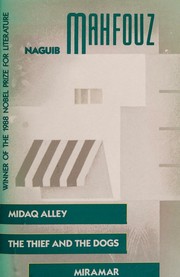 Midaq AlleyLvl 3family saga
 - 1956
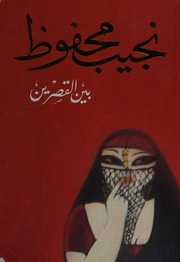 Palace WalkLvl 4family saga
 - 1957
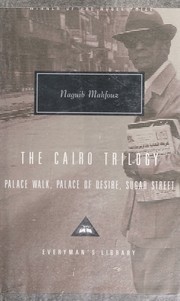 Palace of DesireLvl 5family saga
 - 1957Sugar StreetLvl 5family saga
- 1959
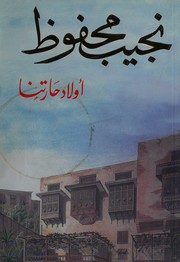 Children of the AlleyLvl 7philosophical novel
 - 1961The Thief and the DogsLvl 6psychological novel
Meanwhile, elsewhere



If you like Mahfouz, try
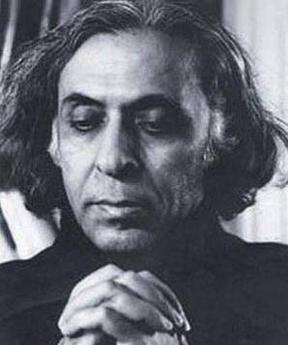
 b. 1957Alaa Al AswanyEgyptshaped by Mahfouz · shared movement: Arabic & Middle Eastern Modern · kindred genres: family saga, historical fiction
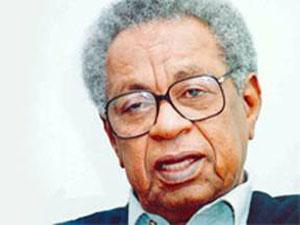 1929–2009Tayeb SalihSudanshaped by Mahfouz · shared movement: Arabic & Middle Eastern Modern · both write in Arabic
 1799–1850Honoré de BalzacFranceshaped Mahfouz · kindred genres: family saga, psychological novel · neighboring movements1933–2004Abdul Rahman MunifSaudi Arabia / Jordanshared movement: Arabic & Middle Eastern Modern · kindred genres: historical fiction, epic · both write in Arabic
 1948–2024Elias KhouryLebanonshared movement: Arabic & Middle Eastern Modern · kindred genres: family saga, historical fiction · both write in Arabic800 CE–900 CEThe Arabian Nights CompilersAbbasid Caliphateshaped Mahfouz · both write in Arabic