
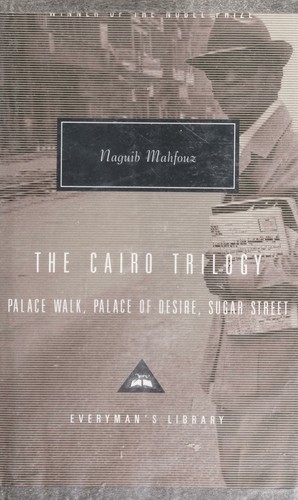
Sugar Street
Naguib Mahfouz · 1911–2006 · Egypt
Originally Al-Sukkariyya (Arabic) · translated by William Maynard Hutchins, Olive E. Kenny, and Angele Botros Samaan
Why it matters
The old patriarch dies and his grandsons split the family down a new fault line, one drawn to Marx and one to the Muslim Brotherhood, as Egypt edges toward the revolution their elders only glimpsed. The trilogy's close: history moving from the household out into the street.
At a glance
A wider political canvas and a third generation of characters to track, though still linear and clear.
Deep dive
By the third generation, al-Sayyid Ahmad's grandsons have scattered his old certainties across the entire map of 1930s and '40s Egyptian politics, and Mahfouz closes the trilogy by watching the family's private compromises finally catch up with its public ones.
Written for readers who have finished the book. No plot recap, and nothing here is safe to read first.
Themes & symbolism
Khadija's sons, Ahmad and Abd al-Muni'm, grow up under the same roof and arrive at opposite political destinations, Ahmad toward Communism, Abd al-Muni'm toward the Muslim Brotherhood, and Mahfouz uses their sibling rivalry to stage, inside one household, the ideological split that will define Egyptian politics for the rest of the century. Neither brother is granted obvious moral superiority: Mahfouz gives each man's convictions real intellectual weight while also showing how much of the divide is driven by ordinary sibling competition dressed up as principle.
Yasin's son Ridwan takes the family's oldest inherited talent, an instinct for pleasing powerful men, and turns it into an actual career, advancing through a relationship with a government minister that the family understands and discusses only in euphemism. Mahfouz draws a direct line from al-Sayyid Ahmad's own hidden appetites, indulged for decades behind a mask of absolute propriety, to Ridwan's calculated use of desire as political currency, the patriarch's hypocrisy metastasized, one generation later, into an entire young man's strategy for advancement.
Kamal's Bachelorhood as the Family's Loudest Silence
Kamal, now a schoolteacher who has never married and has never fully recovered from his youthful humiliation over Aïda, becomes the trilogy's clearest casualty of the crisis of faith he began in Palace of Desire: unable to commit to religious certainty, romantic attachment, or any inherited value with his father's old conviction, he drifts through Sugar Street offering ironic commentary on his nephews' political fevers rather than choosing a fever of his own. Mahfouz uses his uncommitted, skeptical presence as the trilogy's quiet counterweight to Ahmad and Abd al-Muni'm's certainties, the doubt that modernization actually produces standing right next to the convictions it was supposed to replace.
Two Grandsons, One Prison
Mahfouz sets Ahmad's Marxist reading groups and Abd al-Muni'm's Brotherhood cell meetings on parallel tracks through the second half of the novel, letting readers watch two young men convinced they are building opposite futures for Egypt while relying on identical tools, secrecy, recruitment, and an absolute confidence in doctrine neither has actually tested against power yet. The parallel is the point: Mahfouz is less interested in adjudicating between Communism and Islamism than in showing how alike two supposedly opposed certainties look from just outside them.
The last seal: what actually happens, and why it lands the way it does.
The ending, explained
Ahmad is arrested for Communist organizing and Abd al-Muni'm for his Muslim Brotherhood activities within the same stretch of pages, both grandsons hauled off by the same state apparatus despite standing for opposed and mutually hostile visions of Egypt's future, a symmetry Mahfouz clearly intends as his final judgment on where the family's ideological civil war actually leads. Al-Sayyid Ahmad, physically diminished and near death, lives just long enough to learn both grandsons have been taken, the household's founding tyrant reduced to a bystander in a political drama his own descendants are now the casualties of. The trilogy closes with Kamal alone among the family able to watch the arrests with any distance, his refusal to commit to either grandson's certainty reading, by the last page, less like failure than like the one form of survival left available.
Where to go next
 Naguib Mahfouz · 1947Midaq AlleyLvl 3Medium pace
 Naguib Mahfouz · 1956Palace WalkLvl 4Medium pace
 Naguib Mahfouz · 1957Palace of DesireLvl 5Medium pace
 Naguib Mahfouz · 1959Children of the AlleyLvl 7Slow burnNaguib Mahfouz · 1961The Thief and the DogsLvl 6Fast paced
 Alaa Al Aswany · 2002The Yacoubian BuildingLvl 4Fast paced