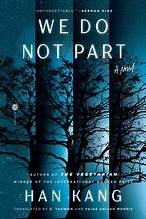
We Do Not Part
Han Kang · b. 1970 · South Korea
Originally Jakbyeolhaji Anneunda (Korean) · translated by e. yaewon and Paige Aniyah Morris
Why it matters
A woman races through a blizzard to Jeju Island to save a friend's bird, and instead uncovers the buried mass graves of the 1948 Jeju uprising. Han Kang's snowbound companion to Human Acts, on memory a state tried to erase.
At a glance
Dreamlike, nonlinear structure blurs the living and the dead across shifting timeframes.
Deep dive
A writer treks through a blizzard to a friend's remote house on Jeju to save a pet bird from starving alone, and finds the island's snow has been quietly keeping something far older buried underneath it.
Written for readers who have finished the book. No plot recap, and nothing here is safe to read first.
Themes & symbolism
Kyungha receives an urgent hospital message from her friend Inseon, injured in a workshop accident in Seoul, asking her to fly immediately to Jeju and save Ama, Inseon's pet bird, from dying of thirst alone in the house. The errand sounds almost absurdly small next to the historical material Han Kang is about to unbury through it, and that scale mismatch is deliberate: Kyungha's increasingly disorienting journey through a worsening snowstorm to reach a single bird becomes the mechanism by which the novel smuggles her, and the reader, toward the Jeju uprising of 1948, when tens of thousands of islanders were killed by state and paramilitary forces in a massacre the South Korean government suppressed from official memory for decades afterward.
Inseon's family, it turns out, has spent years on an amateur, obsessive project of documentation and excavation, searching for the remains of relatives killed in the 1948 violence, including a brother whose fate Inseon's mother spent her whole life trying to establish. Han Kang lets the snow that strands Kyungha on the island function as both obstacle and metaphor at once, an accumulating white erasure that mirrors the state's own decades-long burial of what happened on Jeju, while the specific, painstaking work of digging for actual bones underneath it insists that the past can be recovered, however slowly, by people willing to keep digging.
A Companion Piece Written in Snow Instead of Blood
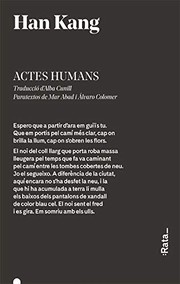
Where Human Acts confronted the 1980 Gwangju massacre through direct, often unbearable physical description, We Do Not Part approaches a comparably vast atrocity, the Jeju uprising's death toll rivals Gwangju's, through indirection, dream logic, and a blizzard that increasingly blurs whether Kyungha is awake, asleep, or already somewhere between them. The formal shift isn't softness; it's Han Kang finding a second instrument for the same lifelong subject, state violence and the labor of remembering it, better suited to an atrocity whose evidence was literally buried in unmarked ground rather than displayed in a city square.
The last seal: what actually happens, and why it lands the way it does.
The ending, explained
As Kyungha's stay on Jeju stretches on, the boundary between Inseon, hospitalized and absent, and a version of Inseon who seems to be present in the house with her collapses entirely, and the novel stops clarifying whether what Kyungha is experiencing is memory, hallucination, or something closer to a haunting the island itself is generating. Rather than resolving that ambiguity, Han Kang lets it stand as the novel's final argument: the dead of 1948, like Ama the bird Kyungha set out to save and the buried relatives Inseon's family has spent years searching for, don't stay conveniently separated from the living, and a nation's refusal to properly bury its own history leaves it exactly this permeable, snow that never quite finishes falling on ground that never quite finishes giving up its dead.