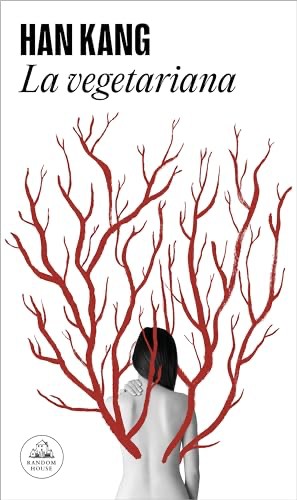
The Vegetarian
Han Kang · b. 1970 · South Korea
Originally Chaesikjuuija (Korean) · translated by Deborah Smith
Why it matters
Yeong-hye stops eating meat, and her quiet refusal detonates through husband, brother-in-law, and sister: violence and the dream of becoming a plant. The International Booker winner that announced Korean fiction to the world.
At a glance
Shifting narrators and disturbing, elliptical imagery resist easy paraphrase.
Deep dive
Three people who love Yeong-hye each fail to understand her in a different, specific way — and what her silence is doing to all of them.
Written for readers who have finished the book. No plot recap, and nothing here is safe to read first.
Themes & symbolism
Yeong-hye's refusal to eat meat starts small and becomes total — she stops eating meat, then cooked food, then food altogether, trying to complete a logic she can't fully explain even to herself: a dream of blood and butchery convinces her that eating anything requires complicity in violence, and the only clean way out is to stop being an animal altogether. Han never gives Yeong-hye a first-person chapter of her own; she appears only through the eyes of the husband who finds her plainness convenient until her refusal becomes an embarrassment, the brother-in-law who eroticizes her withdrawal into an art project, and the sister who has spent her whole life being the reasonable one and can't stop watching her sister disappear. The three-part structure is itself the argument: a woman can be endlessly interpreted, painted, filmed, hospitalized, and diagnosed, and still never once be asked, directly, what she wants.
The Mongolian mark — a birthmark at the base of Yeong-hye's spine that most people lose in infancy but she's kept into adulthood — becomes, in her brother-in-law's hands, proof of something pre-social and plant-like in her, and he paints flowers across her body and films their sex as art rather than betrayal, telling himself desire and aesthetics are the same thing. They aren't, and the novel is precise about the difference: his transgression against his own marriage and hers is dressed in the language of liberation while functioning as one more person deciding what Yeong-hye's body means. Only trees — rooted, photosynthesizing, needing nothing from anyone — offer her a form of being that isn't already claimed by someone else's interpretation, which is why her final ambition isn't death so much as arboreal transformation: to stand in sunlight and simply stop needing to be fed.
Three Unreliable Witnesses
Structurally, the novel withholds Yeong-hye's own voice almost entirely, giving her only italicized, fragmentary dream-passages while three relatives narrate around her in succession. That withholding is the point rather than an oversight: a woman trying to opt out of a violent, appetite-driven world is, by the world's own logic, unintelligible, and the men and woman who love her can only describe the shape of her absence, never the reasoning inside it. By the time In-hye takes over the final section, she's the only narrator who stops trying to explain her sister and simply watches, which is why the ending belongs to her rather than to Yeong-hye.
A Booker-Winning Translation, and Its Critics
Deborah Smith's English translation won the 2016 International Booker Prize jointly with Han and introduced Korean fiction to a mass Anglophone audience for the first time, but it also drew sustained criticism from Korean-literature scholars for embellishments and outright errors — added imagery, softened or intensified lines that don't exist in the original. The controversy became its own case study in what gets lost, and invented, when a spare, often clinical Korean prose style is rendered into a more lyrical English idiom — a fittingly contested afterlife for a novel already obsessed with how badly people translate each other.
The last seal: what actually happens, and why it lands the way it does.
The ending, explained
The final section belongs to In-hye, the one relative who never tried to possess or explain Yeong-hye, only to keep her alive. Visiting the psychiatric hospital, In-hye finds her sister skeletal and still refusing food, doing handstands because she believes she can nourish herself like a tree, roots in the air. When the hospital moves to force-feed her, In-hye intervenes and rides with her by ambulance to a different hospital, still trying to save a life Yeong-hye insists she doesn't want back in this form. Yeong-hye murmurs that she doesn't need food anymore, only sunlight. In-hye, exhausted and complicit in nothing except love, stares out at the trees blazing along the road — a color that reads as both funeral and defiance — and the novel ends on her unresolved, watching gaze rather than on any answer.