
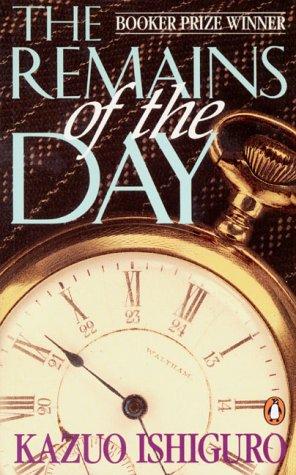
The Remains of the Day
Kazuo Ishiguro · b. 1954 · England / Japan
Why it matters
A butler motors through England defending a life of perfect service to a master history has disgraced. The unreliable narrator's finest hour: dignity, repression, and a love unspoken until too late.
At a glance
Restrained first-person voice hides its meaning beneath calm, formal sentences.
Deep dive
Why Stevens's own definition of 'dignity' — never letting the professional mask slip — is the real subject of this novel, and what nearly cracks it on a pier at Weymouth.
Written for readers who have finished the book. No plot recap, and nothing here is safe to read first.
Themes & symbolism
Stevens narrates in a register built for not saying things: his account of Lord Darlington's Nazi appeasement — hosting the 1923 conference, dismissing two Jewish housemaids on Darlington's orders, later denying to a guest that he ever did so — arrives in the same flattened professional tone he uses for silver-polishing technique, and the gap between what he reports and what the reader assembles is the novel's whole method. "Dignity," as Stevens defines it, means never letting the professional mask slip — "wearing it like a decent suit of clothes" — a doctrine of self-erasure so total that it kept him serving port to men deciding Europe's fate down the hall from the room where his own father lay dying.
Miss Kenton's flowers, her habit of standing too close, her small campaigns against his emotional armor, culminate in a relationship declared and closed entirely in retrospect: he recalls the afternoon she cried behind a closed door, grieving her aunt, as an occasion he "did not feel it appropriate to enter." The real subject is repression as a national style as much as a personal one — Darlington Hall's fading grandeur and the English landscape Stevens praises for its lack of drama become a metaphor for a class, and a country, that mistook restraint for virtue and appeasement for diplomacy, with comparable results in both the manor and the ballroom of Europe.
The Gap Between the Telling and the Told
Stevens's unreliability isn't outright lying so much as constant retroactive reframing — mid-novel he denies to a couple that he ever worked for Lord Darlington, then spends pages justifying the denial to himself rather than simply regretting it. Ishiguro supplies the actual scenes in flashback, so the discrepancy between what Stevens claims and what the reader has just watched happen does the novel's real emotional work, largely without Stevens ever noticing it happening.
Darlington Hall as Political Microcosm
The 1923 conference scene stages appeasement literally below stairs, with servants overhearing statesmen rehearse arguments that would harden into Munich fifteen years later. Stevens's professional creed — "it is not my place to have an opinion" — mirrors and quietly enables Darlington's own moral abdication, making service itself a form of complicity the novel keeps sympathetic to Stevens without ever letting him fully off the hook.
The last seal: what actually happens, and why it lands the way it does.
The ending, explained
On the pier at Weymouth, Stevens finally meets Miss Kenton, now Mrs. Benn, after two decades apart, and she admits she sometimes imagines the life they might have had — but has decided to stay with her husband, now that a grandchild is on the way and her daughter needs her. Stevens tells her this news "turns his heart," the closest the novel lets him come to confessing anything. Alone afterward, he weeps briefly to a stranger on the pier who tells him the evening is the best part of the day. Rather than sit with the loss, Stevens resolves to return to Darlington Hall and work on his "bantering" to better please his new American employer, Mr. Farraday — redirecting a lifetime of foreclosed feeling into one more act of professional self-improvement, the bleakest and most fitting close the novel could give him.
Where to go next
 Kazuo Ishiguro · 1982A Pale View of HillsLvl 4Slow burn
 Kazuo Ishiguro · 1986An Artist of the Floating WorldLvl 4Slow burn
 Kazuo Ishiguro · 2005Never Let Me GoLvl 4Medium pace
 Kazuo Ishiguro · 2015The Buried GiantLvl 5Slow burn
 Han Kang · 2007The VegetarianLvl 6Fast paced
 Samanta Schweblin · 2014Fever DreamLvl 6Fast paced