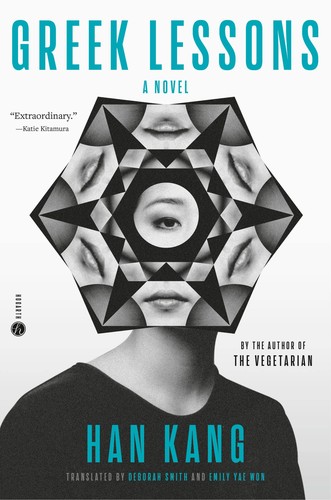
Greek Lessons
Han Kang · b. 1970 · South Korea
Originally Huirabeo Sigan (Korean) · translated by Deborah Smith and Emily Yae Won
Why it matters
A woman who has lost the power of speech and a teacher slowly losing his sight meet over a classroom of ancient Greek grammar, groping toward each other past language's collapse. Han Kang's quietest novel: loss rendered in the body's own vocabulary.
At a glance
Alternating close interior perspectives and dense, poetic prose with little conventional plot.
Deep dive
A woman who has stopped being able to speak and a teacher slowly going blind meet over a classroom of ancient Greek grammar, and Han Kang lets two people who can barely perceive each other find a way in anyway.
Written for readers who have finished the book. No plot recap, and nothing here is safe to read first.
Themes & symbolism
Han Kang gives neither of her two protagonists a name: the woman, who has lost the ability to speak for the second time in her life, first as a teenager and now after losing custody of her son, enrolls in a private class on ancient Greek partly out of desperation and partly because a dead language, spoken by no one, feels like the only kind of speech that isn't already implicated in her failure to use the living one. The man teaching the class is losing his eyesight to an inherited condition that claimed his mother's vision before his, and Han Kang builds the novel almost entirely out of the asymmetry between them, a woman who can't produce language and a man who can no longer fully see the person producing it.
The ancient Greek itself isn't incidental technical detail; Han Kang draws specifically on Greek grammar's middle voice, a verb form that sits between active and passive, neither fully doing an action nor fully having it done to you, and uses it as the novel's clearest image for what both protagonists are experiencing, grief and loss that neither of them chose but that they are nonetheless left to carry out, to inhabit, in a state the ordinary grammar of active or passive doesn't have room for.
A Grammar for Griefs Neither Active nor Passive
Han Kang lingers on the middle voice specifically because it names something her two protagonists otherwise have no vocabulary for: neither the woman's muteness nor the teacher's blindness is something either of them is doing, exactly, and neither is purely happening to them from outside either, since both conditions are entangled with choices, memories, and inherited bodies that resist a clean subject-object account. The grammar lesson becomes, without either character remarking on it directly, the novel's real thesis about how loss actually works, always somewhere between an action and an accident. The teacher's own memory of a childhood spent partly in Germany, learning a second language from scratch as a small child, doubles the point: he has already lived once through the disorientation of a self that has to be rebuilt word by word, long before his vision started failing him.
The last seal: what actually happens, and why it lands the way it does.
The ending, explained
As the teacher's remaining sight narrows to almost nothing, and the woman's silence continues to resist every therapeutic attempt to break it through ordinary means, the two of them arrive at contact that bypasses speech and sight altogether: he traces the Greek alphabet onto her palm, and later into the air, and she responds with her body in ways she still can't manage with her voice. Han Kang doesn't resolve either condition, the woman's muteness isn't cured and the teacher's blindness isn't halted, but closes on a fragile, wordless intimacy built entirely out of touch, in which the failure of two ordinary senses becomes the exact condition that lets something pass between them that speech, for both of them, had already failed to carry.