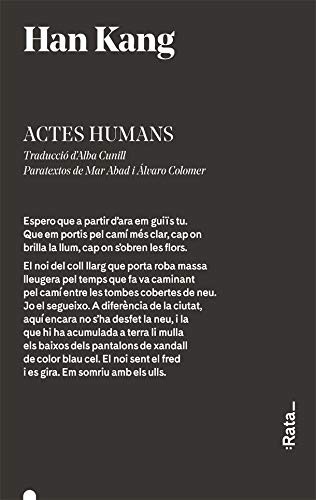
Human Acts
Han Kang · b. 1970 · South Korea
Originally Sonyeoni Onda (Korean) · translated by Deborah Smith
Why it matters
The 1980 Gwangju massacre told through the dead and the surviving: beginning in a gymnasium of bodies, ending in the author's own return. Han Kang's requiem; the Nobel citation's 'confront[ing] historical traumas' starts here.
At a glance
Fractured multi-voiced structure spanning decades, including a second-person chapter.
Deep dive
Six people carry the same few days in Gwangju forward through decades, a torture cell, a censor's office, and a voice that keeps narrating long after its body has stopped being useful to it.
Written for readers who have finished the book. No plot recap, and nothing here is safe to read first.
Themes & symbolism
Han Kang refuses a single continuous narrator for the 1980 Gwangju uprising, and the refusal is the argument rather than a stylistic flourish: state violence doesn't end when the shooting stops, it radiates outward through the people who survive it, so the novel tracks the same handful of days across a schoolboy, a corpse, an editor, a former prisoner, and a mother, each picking up where the last one's silence begins. Dong-ho, a middle-school student who stays behind at the provincial gymnasium to help catalog the dead rather than go home, opens the book addressed in second person, a device that puts the reader inside a fear too large for first person to hold steady.
The novel's most unsettling formal choice comes in its second chapter, narrated by Dong-ho's friend Jeong-dae from somewhere above his own decomposing body, watching soldiers handle and eventually burn the pile of corpses he's part of. Giving a corpse first-person testimony isn't a gothic flourish; it insists that the desecration of the dead is its own distinct atrocity, separate from the killing that produced them, and that a victim doesn't stop being a subject of experience the instant his body stops functioning.
Later chapters, an editor fighting state censorship of a play about the massacre, a survivor of the torture that followed the crackdown, a mother still keeping vigil decades on, extend the uprising's damage well past 1980 without ever letting a reader treat any single year as the story's true ending. Han binds the sections together with small recurring details, a specific rain, candle wax, the gymnasium's corpse register, rather than plot, which is exactly how she wants the trauma to travel: laterally, through objects and habits, not through a tidy chain of cause and effect.
Six Voices, One Boy
Each narrator after the first carries some fragment of Dong-ho forward, a memory of his face, a guilt about a choice made near him, an object connected to that week, so that the book functions as a relay rather than a set of disconnected case studies. The risk of an episodic structure like this is fragmentation, and Han manages it by making the connective tissue material rather than explanatory: nobody delivers a summary of what happened to Dong-ho, but every chapter is shaped, however indirectly, by his absence.
The Epilogue as Confession, Not Postscript
The final section drops the novel's fiction entirely and lets Han Kang speak as herself, describing her own research into the massacre and the real boy whose story shaped Dong-ho, a family her own had once shared a house with before moving away not long before the killings began. That coincidence, a house she might have still been living in when the soldiers arrived, is the closest the book comes to explaining why Han felt obligated to write it at all, and the epilogue functions less as a wrap-up than as a writer admitting the limits of what invented testimony can do for a massacre South Korea's own government spent years falsifying and undercounting.
The last seal: what actually happens, and why it lands the way it does.
The ending, explained
The novel doesn't build to a single climactic scene so much as let its accumulated testimonies settle into Han Kang's own closing account of returning to Gwangju to research the book directly. She describes tracking down the real family whose son the character of Dong-ho is drawn from, and finding that her own family had lived in their house before the uprising, a detail that turns the entire preceding novel into something closer to a debt being paid than a story being told. There's no reckoning delivered by the state, no trial that sets the record straight within the book's own timeline. What Han offers instead is witness sustained across enough years and enough voices that the massacre can't be filed away as a single settled date.