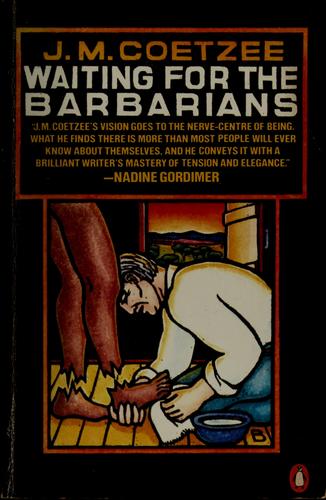
Waiting for the Barbarians
J. M. Coetzee · b. 1940 · South Africa / Australia
Why it matters
A frontier magistrate of a nameless Empire drifts from complicity into futile decency as the torturers arrive. Coetzee's timeless parable: every regime that needs an enemy finds itself here.
At a glance
Spare allegorical prose is accessible on the surface but demands unpacking its parable's ambiguity.
Deep dive
The Magistrate has spent decades peaceably administering a frontier outpost of an unnamed Empire, until Colonel Joll arrives hunting an enemy nobody in the town has actually seen, and the Magistrate's own conscience becomes the real frontier under interrogation.
Written for readers who have finished the book. No plot recap, and nothing here is safe to read first.
Themes & symbolism
Coetzee refuses the novel a country, a century, or even a named enemy: the barbarians the Empire is supposedly defending its frontier against never materialize as an organized threat anywhere in the book, only as scattered nomadic families the Magistrate has traded and coexisted with peaceably for years. That vacancy is the entire argument. Colonel Joll's Third Bureau needs an enemy to justify the violence it has already decided to commit, and Coetzee builds Joll's interrogation methods, applied indiscriminately to an old man and a boy and then escalated across the book, as a machine that manufactures the confession it requires rather than uncovering any truth that was actually there.
The Magistrate takes in a blinded, partially crippled barbarian girl, one of Joll's earlier victims, and spends months in a ritual he cannot fully explain even to himself, washing and oiling her broken feet and scarred body night after night, less out of desire than out of a scholarly, almost forensic need to read the marks torture left on her, as if close enough attention could retroactively undo what was done. Coetzee is unsparing about how much this care still uses her, an echo, softened but not erased, of Joll's own violation, and the Magistrate's discomfort with that resemblance runs underneath the whole relationship without ever fully surfacing into confession on his part.
The Magistrate's decision to personally escort the girl back across the frontier to her people is the closest the novel comes to atonement, and it costs him exactly what atonement should cost inside Joll's Empire: on his return he is arrested as a collaborator, stripped of his post, and eventually tortured and publicly humiliated himself, hung by his wrists in the town square and dressed in a woman's smock for the crowd's amusement. Coetzee puts the Empire's own administrator through its machinery to make the point unmissable, that there was never a special exemption available to the men who ran it, only a temporary one, revocable the moment they stopped being useful.
An Empire With No Century
Coetzee sets the novel nowhere specific and nowhen specific on purpose: no nation is named, no date given, and the technology on display, horses, torture implements, sunglasses Joll wears that read as pointedly anachronistic, refuses to settle into any single historical moment. Written in 1980, deep inside apartheid South Africa's own state of emergency, the novel's studied placelessness let Coetzee indict imperial violence as a structure repeatable in any century rather than a scandal specific to one government, a strategy he later defended as a refusal to let the state dictate even the terms of the fiction written against it.
The last seal: what actually happens, and why it lands the way it does.
The ending, explained
The Empire's grand punitive expedition against the barbarians collapses ignominiously: soldiers are lured into the desert and picked apart by an enemy that mostly declines to fight them directly, and the survivors straggle back starving, deserting in numbers, while Joll himself flees the town in disgrace rather than face what his war has actually produced. The Magistrate, reinstated by default once there is no one left to run the town, is left presiding over a garrison dissolving into chaos and cold, with no barbarian army ever having appeared to justify any of it. Coetzee ends not on a battle but on the Magistrate's own unfinished reckoning with his complicity, still turning over what he could have refused sooner and did not.