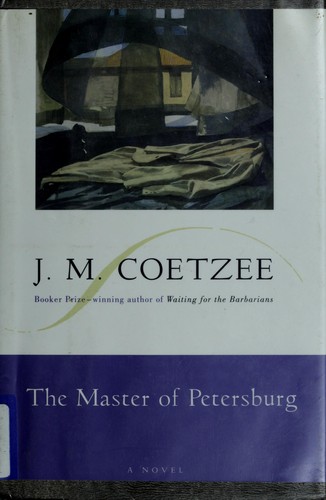
The Master of Petersburg
J. M. Coetzee · b. 1940 · South Africa / Australia
Why it matters
Dostoevsky returns to Petersburg to claim his dead stepson's belongings and finds himself drawn into the same revolutionary underground his own fiction indicted. Coetzee imagines the master novelist from the inside, grief curdling into the moral extremity he wrote about.
At a glance
A brooding imagined interiority for a real historical figure, thick with Dostoevskian argument and dread.
Deep dive
Dostoevsky returns to Petersburg to bury his stepson and instead finds himself drawn into the same revolutionary conspiracy he suspects had a hand in the boy's death, with a real, unfinished manuscript waiting at the end of the investigation.
Written for readers who have finished the book. No plot recap, and nothing here is safe to read first.
Themes & symbolism
Coetzee borrows Dostoevsky's biography only partway: the real Pavel Isaev, his stepson, outlived him, but Coetzee kills the boy off before the novel opens and sends a grieving, epileptic Dostoevsky back to Petersburg to claim his effects and understand a death that suicide or foul play never conclusively settles. Grief and investigation blur into each other from the first pages: moving into Pavel's old rented room, sleeping in his bed, wearing his coat, Dostoevsky is less solving a case than trying to inhabit a dead son closely enough to somehow still reach him.
Anna Sergeyevna, Pavel's landlady, becomes Dostoevsky's lover within days of his arrival, an affair Coetzee narrates with unusual sexual directness for the corpus, and Dostoevsky's simultaneous, unexamined fascination with her adolescent daughter Matryosha sits uncomfortably close to material Dostoevsky himself was working on at the time, the suppressed chapter of his real novel Demons, in which the revolutionary Stavrogin confesses to violating a child. Coetzee is not simply borrowing period detail here, he is staging the private psychological material Dostoevsky's fiction would go on to sublimate, watching the novelist live dangerously close to what he will later have to write.
Sergei Nechaev, the real revolutionary whose killing of a former comrade inspired Demons, appears in the novel in hiding, manipulating Dostoevsky with genuine cunning: he needs the older man's fame to radicalize Petersburg's students, and he is entirely willing to use Pavel's unexplained death, whether or not his own group caused it, as raw material for that purpose. Coetzee makes Nechaev a version of what a novelist can become without conscience, someone who understands narrative's power over people completely and uses it with none of the moral hesitation Dostoevsky is still, however compromised, capable of feeling.
Writing the Chapter History Suppressed
The historical Stavrogin's Confession, Chapter Nine of Demons, in which the novel's central revolutionary admits to violating a child and driving her to suicide, was cut by Dostoevsky's own editor and not published until decades after his death. Coetzee's final chapter, titled simply Stavrogin, shows his fictional Dostoevsky beginning to write that exact material, transmuting Pavel, Matryosha, and his own culpability directly into fiction. The Master of Petersburg ends, in effect, at the exact threshold of the real, suppressed manuscript it has been building toward the whole time, Coetzee's most direct statement anywhere in his work about what novelists actually do with the people closest to them.
The last seal: what actually happens, and why it lands the way it does.
The ending, explained
Convinced Nechaev's circle bears responsibility for Pavel's death but unable to prove it, Dostoevsky is pressed by the police to write a pamphlet blaming the authorities instead, and refuses; the account he does write, naming his suspicions of Nechaev, is exactly what Nechaev wanted circulated all along, since it inflames the students against establishment figures like Dostoevsky himself rather than against the regime. As riots spread through the city, Dostoevsky, implicated in the very violence he tried to investigate honestly, sits down to write, transposing Pavel, Matryosha, and his own guilt directly into what will become the suppressed confession chapter of Demons. Coetzee ends on the act of writing itself as the only reckoning available, not innocent, not a solution, just the only tool the novelist actually has.