
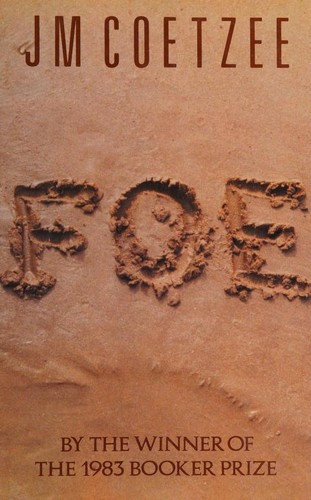
Foe
J. M. Coetzee · b. 1940 · South Africa / Australia
Why it matters
Susan Barton washes ashore on Cruso's island, outlives him, and returns to London to fight the novelist Mr. Foe for authorship of her own castaway story, while Friday, his tongue cut out, cannot tell his. Coetzee's rewrite of Robinson Crusoe asks whose voice actually survives into the book.
At a glance
A metafictional frame nesting Crusoe's tale inside letters and a silenced narrator resists easy resolution.
Deep dive
Susan Barton survives Cruso's island and comes home determined to have her story told exactly as it happened, only to discover that neither the novelist she hires nor the silent man she rescues will let her control it.
Written for readers who have finished the book. No plot recap, and nothing here is safe to read first.
Themes & symbolism
Coetzee strips Crusoe's adventure down to almost nothing on purpose: Cruso, spelled without the final e Defoe gave him, has kept no journal, built no elaborate fortifications, and shows no interest in being rescued after more than a decade alone on the island with Friday, a man whose tongue is missing for reasons Cruso offers three different, contradictory explanations for and never settles. Susan Barton, washed ashore after a mutiny, is appalled by how little of the heroic castaway myth she finds waiting for her, and the novel's first movement is her slow realization that the story she assumed she had landed inside does not actually exist yet, only a bare, undramatic survival someone will eventually have to write into shape.
Once back in London, Susan seeks out the writer Daniel Foe to turn her account into a book, and the struggle that follows is over who owns a life once it becomes a narrative: Foe wants to add a lost daughter, a mutiny, romance, everything the market wants from a castaway tale, while Susan insists on the plain, uneventful truth of what happened to her and Cruso, who dies at sea before ever reaching England. A girl claiming to be Susan's long-lost daughter turns up and attaches herself to her, and Susan becomes convinced, without ever being able to prove it, that Foe planted her, a fiction inserted into her life to make her own story more sellable.
Friday's silence is the novel's real subject and its deliberate limit: every character, Susan most persistently, tries to get him to communicate what happened to his tongue and what he actually wants, and Coetzee refuses every one of those attempts a payoff. Susan teaches him single written words, draws him pictures, watches him circle endlessly in a small boat off the coast, and none of it produces the access she is looking for. The novel builds its whole ethics around that refusal: a story about a man once literally silenced by slavery does not get to also claim, on the page, that it has finally found the words for him.
Foe Without the De
Daniel Defoe was born Daniel Foe and added the aristocratic-sounding De to his own name as an adult, a detail of self-invention Coetzee restores by naming his fictional author simply Foe, a novelist whose entire trade is putting a more marketable shape onto other people's raw material, starting with his own. The joke lands harder once Susan Barton, herself narrating events the real Robinson Crusoe never mentions a woman witnessing, spends the book fighting the very novelist who will supposedly go on to publish something called Robinson Crusoe for the right to tell her own story her own way.
The last seal: what actually happens, and why it lands the way it does.
The ending, explained
The novel's final section abandons Susan's narration for an unidentified voice that enters the wreck of the ship Susan and Cruso once sailed on, now sunk and silted at the bottom of the sea, and finds Friday's body there, his throat opening to release what the prose calls a slow stream, and then breaks off mid-sentence rather than naming what the stream actually is. Coetzee refuses to supply the sound, water, or word that would finally let Friday speak on the novel's own terms. The gesture reads as Coetzee's clearest statement about the entire book: any authorial rescue of Friday's silence, including his own, would just be another Foe writing another convenient ending onto a story that is not his to finish.
Where to go next
 J. M. Coetzee · 1980Waiting for the BarbariansLvl 5Medium pace
 J. M. Coetzee · 1983Life & Times of Michael KLvl 6Slow burn
 J. M. Coetzee · 1990Age of IronLvl 6Slow burn
 J. M. Coetzee · 1994The Master of PetersburgLvl 7Slow burn
 J. M. Coetzee · 1999DisgraceLvl 5Medium pace
 Damon Galgut · 2021The PromiseLvl 6Medium pace