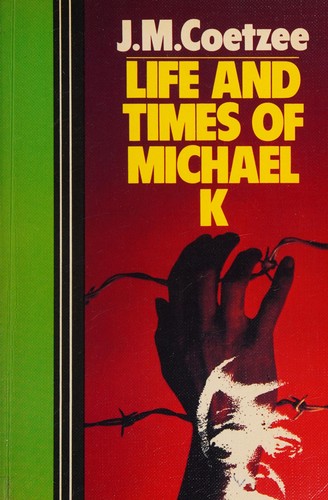
Life & Times of Michael K
J. M. Coetzee · b. 1940 · South Africa / Australia
Why it matters
A simple gardener carries his dying mother across a South Africa torn by civil war, then tries to live off the land alone. Coetzee's Booker-winning parable of the individual who slips through every camp and category the state builds.
At a glance
Spare prose masks a deeply allegorical, deliberately opaque central consciousness.
Deep dive
A man spends a civil war disappearing, patiently and almost wordlessly, from every system built to account for him.
Written for readers who have finished the book. No plot recap, and nothing here is safe to read first.
Themes & symbolism
Michael K's harelip and simplicity are treated by the state, camp doctors, and even the well-meaning as something to interpret, diagnose, or fix — but Coetzee's real interest is in K's persistent illegibility on anyone else's terms. He wants nothing more than to grow food quietly for himself, and every institution he passes through — labor camps, rehabilitation camps, hospitals — is baffled and eventually undone by a man with no political demand to make, nothing to confess, and no interest in being saved, categorized, or used. His silence and evasiveness aren't passivity so much as the only form of freedom left available to someone with no power to resist directly.
The medical officer's extended first-person section near the novel's end, narrating his own escalating fascination with and inability to understand K, states the theme from the opposite side: an educated, humane man who genuinely wants to help K is nevertheless revealed as incapable of imagining a person who doesn't want anything his own frameworks — rehabilitation, nutrition, political categorization as friend or enemy — can register. Coetzee uses him to show how total institutional goodwill remains a form of the same violence as institutional cruelty, once it insists a person answer to its terms at all.
K's obsessive, near-devotional cultivation of pumpkins and melons on his mother's abandoned family land is the novel's clearest image of a value system entirely outside the war being fought around him — he isn't growing food to sell, resist, or even really to survive on for very long, but because tending something quietly to its own completion is the one form of meaning the surrounding chaos hasn't managed to colonize or requisition.
An Apartheid Novel Without a Political Speech
Written and published in the final, most violent decade of apartheid, the novel is pointedly light on direct commentary about the regime, staying almost entirely inside K's narrow, literal, present-tense consciousness. Critics have long debated whether that restraint is itself a political statement — refusing to instrumentalize a Black South African character's suffering into a mouthpiece for the author's own argument — or a kind of evasion, and the ambivalence has stayed current decades after the Booker win rather than resolving one way or the other.
The last seal: what actually happens, and why it lands the way it does.
The ending, explained
Having escaped the camps and drifted, starving, back toward Cape Town and the ruined house where his mother once worked, K is picked up and questioned again, but the novel declines to resolve his fate through any external verdict. It closes instead inside his own imagination: a return to the abandoned garden plot near the house, where he pictures surviving by lowering a teaspoon tied to a length of string down a hole to draw water, a method so minimal it barely qualifies as a plan. The image is the novel's actual argument rather than a coda to it — survival, and even a kind of freedom, are available to K not through any system's rehabilitation but through radical self-sufficiency at the very edge of subsistence, an answer to the war that refuses to be either triumphant or defeated, simply outside its terms entirely.