
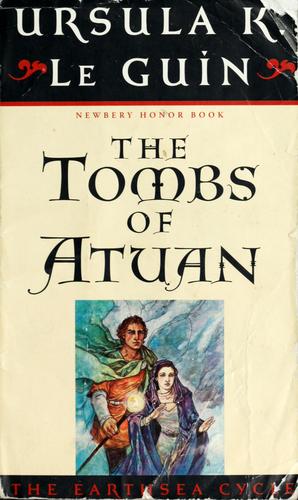
The Tombs of Atuan
Ursula K. Le Guin · 1929–2018 · United States
Why it matters
A girl chosen as a child to serve a nameless dark power spends her life sealed inside a lightless underground labyrinth, until a thief named Ged breaks in. Earthsea's inward, claustrophobic sequel trades the first book's quest for ritual, faith, and escape.
At a glance
A confined, ritual-heavy setting and a slow-building escape plot ask for patience.
Deep dive
What it means that Tenar's name gets eaten by the Nameless Ones before she's old enough to remember owning it, and why the thief who breaks into her lightless kingdom matters less than what happens to the name itself once he does.
Written for readers who have finished the book. No plot recap, and nothing here is safe to read first.
Themes & symbolism
Tenar, chosen as a small child to be the reincarnation of the First Priestess, has her name ceremonially taken, eaten, by the Nameless Ones and replaced with a title, Arha, the Eaten One. Le Guin makes that loss of name, not any physical wall, the real captivity of the book: Arha spends her whole remembered life administering a labyrinth she was taught to fear rather than understand, guarding treasure and presiding over executions for gods whose actual power the novel keeps carefully, deliberately unconfirmed, since nothing definitively supernatural happens in the Tombs except what Arha herself and the priesthood's ritual produce.
The contrast with Ged's own book is deliberate. Where A Wizard of Earthsea is external and propulsive, a boy's quest outward into danger, this one is claustrophobic and interior, narrated entirely from inside Arha's institution and her own ritual-saturated understanding of it. It isn't a rite of passage into power, it's a slow recognition that the structure holding her was built on taking her name away and calling the theft an honor. Ged, once she catches him trespassing in the dark, functions less as a rescuer than as an outside fact that finally makes the shape of her own cage visible to her.
Kossil, Thar, and a Theocracy With No God Behind It
The priesthood's internal politics, Kossil's open hostility to the old ways and Thar's exhausted loyalty to a fading order, suggest an institution that may have long since become self-perpetuating ritual, sustained by fear and administrative habit rather than any actual Nameless Ones. Le Guin lets that possibility sit unresolved, and it's the more frightening reading: not that dark gods rule the Tombs, but that nothing does, and the machinery keeps running anyway.
Kossil, unlike Thar, has stopped even pretending to believe in the Nameless Ones as anything other than a lever for her own authority, and her pragmatic cruelty toward Arha reads as the institution's true face once the last true believer is gone. Le Guin's choice to make the more openly threatening priestess also the more openly cynical one suggests the Tombs were never really guarded by darkness at all, only by whoever was willing to keep insisting the darkness mattered.
The last seal: what actually happens, and why it lands the way it does.
The ending, explained
Increasingly convinced no divine authority is actually watching, Arha helps Ged retrieve the missing half of the Ring of Erreth-Akbe from the treasury's darkness, and their escape sets off an earthquake that buries the Tombs, the priesthood's entire physical seat of power, in an instant. Reaching the surface with Ged, she has to choose a name for the first time in her adult memory, and it's Ged who gives her back Tenar, guessed or perhaps simply remembered rather than invented, restoring what the opening ceremony took. Le Guin ends not on romance or triumph but on Tenar facing an unfamiliar, ordinary world she has no practice living in, free for the first time and visibly frightened by what that freedom actually requires.
Where to go next
 Ursula K. Le Guin · 1968A Wizard of EarthseaLvl 3Fast paced
 Ursula K. Le Guin · 1969The Left Hand of DarknessLvl 6Medium pace
 Ursula K. Le Guin · 1971The Lathe of HeavenLvl 5Fast paced
 Ursula K. Le Guin · 1974The DispossessedLvl 6Medium pace
 Ted Chiang · 2002Stories of Your Life and OthersLvl 5Medium pace
 Philip K. Dick · 1962The Man in the High CastleLvl 6Medium pace