
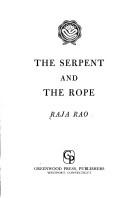
The Serpent and the Rope
Raja Rao · 1908–2006 · India
Why it matters
A Brahmin scholar's marriage to a Frenchwoman becomes the occasion for an extended meditation on Vedanta, illusion, and the gulf between Indian and Western metaphysics. Rao's densest novel, and the one many consider his true masterpiece.
At a glance
Long philosophical digressions on Vedantic thought outweigh plot for extended stretches.
Deep dive
A Brahmin scholar spends his marriage to a Frenchwoman discovering that the argument he's really having is between two civilizations' entire way of knowing what's real, and it isn't the one either of them expected to lose.
Written for readers who have finished the book. No plot recap, and nothing here is safe to read first.
Themes & symbolism
Rama, a Mysore Brahmin doing doctoral work in Aix and Paris on the medieval Albigensian heresy, frames his marriage to the Frenchwoman Madeleine in the same categories he's using on his dissertation, an actual French heresy about matter and spirit standing in for a union that keeps failing to reconcile the same two terms. The title's operating image, the rope mistaken for a serpent in bad light, that Advaita Vedanta uses to describe how illusion gets laid over reality, isn't decoration: Rama keeps asking, of Madeleine, of France, of his own scholarship, which parts are the rope and which parts fear has taught him to see as a snake.
Madeleine's own trajectory runs the comparison in the opposite direction: rather than converting to Rama's Vedanta, she drifts toward an austere Buddhism of her own, refusing food and eventually intimacy, so that the marriage's failure isn't one partner's tradition defeating the other's but two searches for the absolute running in parallel without ever really touching. Rao gives Madeleine real intellectual weight rather than making her simply the West Rama has to outgrow, which is what keeps the novel's comparative philosophy from curdling into a lecture.
Savithri, the Indian woman Rama meets and never marries, carries the novel's clearest statement of its own method: what passes between them stays almost entirely unconsummated, conversation, letters, the charge of a single dance, because Rao needs an example of desire that never collapses into possession to make his Vedantic point stick, that the real is what you can't grasp and still doesn't stop being real.
A Dissertation on Heresy as the Novel's Real Argument
Rama's academic subject, the medieval Cathar heresy of southern France with its own dualism of a good spiritual god and an evil material one, gives Rao a European precedent for exactly the mind and matter split he's diagnosing in his own marriage and in the West more broadly, and the novel trusts its reader to map Rama's scholarship onto his life without ever making the parallel explicit on the page.
Rao's English as a Sanskrit Instrument
Written by a Kannada-born author working in English, the prose keeps importing the syntax and rhetorical habits of Sanskrit philosophical argument, long qualified sentences, repetition as emphasis rather than padding, so that the novel's form is already making its content's case: English can carry Vedanta's way of thinking without being translated out of it first.
The last seal: what actually happens, and why it lands the way it does.
The ending, explained
The marriage finally collapses under weight the novel has been adding since the death of Rama and Madeleine's infant son seven months after his birth, a loss neither parent recovers from in the same way. Madeleine retreats into her own ascetic Buddhism, and the divorce that follows reads less as failure than as an overdue admission that two people had spent years married to each other's traditions rather than to each other. Freed of the marriage, Rama travels to Travancore in South India to take a guru as a disciple, the novel's closing move a return not to a woman or a place but to the philosophical ground, Advaita Vedanta itself, his scholarship and his marriage had been circling all along. Rao gives him the ending as relief rather than defeat: the rope, at last, recognized as a rope.
Where to go next
 Raja Rao · 1938KanthapuraLvl 6Medium pace
 Mulk Raj Anand · 1935UntouchableLvl 3Fast paced
 U. R. Ananthamurthy · 1965SamskaraLvl 6Slow burn
 O. V. Vijayan · 1969The Legends of KhasakLvl 7Slow burn
 Alan Paton · 1948Cry, the Beloved CountryLvl 4Medium pace
 Ayi Kwei Armah · 1968The Beautyful Ones Are Not Yet BornLvl 6Slow burn