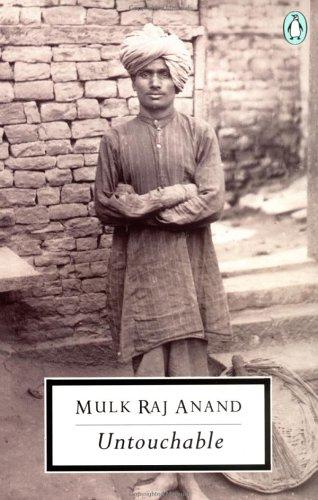
Untouchable
Mulk Raj Anand · 1905–2004 · India
Why it matters
A single day in the life of a Delhi latrine-cleaner renders his humanity against the systematic degradation of the caste he was born into. A pioneering, unflinching landmark of Indian fiction in English.
At a glance
Short, plain, single-day narration; the difficulty is moral rather than stylistic.
Deep dive
One day in the life of a young sweeper who is slapped in the street for touching the wrong person by accident, and the three entirely different answers the novel puts in front of him for how someone in his position might ever be free of that.
Written for readers who have finished the book. No plot recap, and nothing here is safe to read first.
Themes & symbolism
Anand compresses the whole novel into a single day inside Bakha's life as a sweeper and latrine-cleaner in a cantonment town, a structural choice that refuses the reader any relief: there's no montage of years passing to soften what accumulates in these particular twenty-four hours, only one indignity after another delivered in real time. Bakha is slapped in the open street by a Hindu merchant he brushes against by accident, an incident that draws a crowd and public accusations of pollution rather than any acknowledgment that the touch was unintentional, and Anand stages it with enough physical detail, the raised hand, the gathering onlookers, that the scene reads less like an isolated cruelty than like an entrenched procedure everyone present already knows how to perform.
Bakha's private aspirations, his admiration for the clean khaki uniforms and brisk manners of British soldiers, his wish for trousers like theirs, sit uneasily against his social position: Anand doesn't let this read as simple colonial mimicry, since Bakha's longing is really for the plain dignity of not being touched, not being shouted at, not being made to announce his presence with a warning cry wherever he walks, and the only model available to him for that dignity happens to be borrowed from the colonizer.
By nightfall Bakha has also watched his sister Sohini nearly assaulted by a temple priest who then publicly accuses her of polluting him to cover his own guilt, an episode that makes the novel's argument explicit: caste purity rules aren't a neutral religious system, they're a convenient alibi the powerful reach for whenever it suits them.
Three Solutions Offered in One Evening
In the space of the novel's final chapters, Bakha overhears three entirely different answers to his situation without the narrative endorsing any of them outright: a Christian missionary's offer of conversion, delivered with a patronizing certainty that doesn't actually see Bakha as anyone in particular; Gandhi's public address on the need to elevate the Harijans within a reformed Hinduism, met with real emotion from the crowd but no concrete change to Bakha's morning; and, overheard from two young men discussing sanitation reform, a case for the machine-flush latrine that would abolish manual scavenging as a profession altogether rather than asking anyone to feel differently about the people who currently do it.
A Novel That Refuses Its Own Ending
Anand was a committed socialist, and the flush toilet solution he stages last, and lingers on longest, reads as his own quiet preference for material change over moral persuasion, but he stops well short of having Bakha choose, sending him home still turning the day's three options over with no resolution in sight, because the point isn't which idea wins the argument, it's that Bakha's actual freedom depends on decisions made by people who aren't him.