
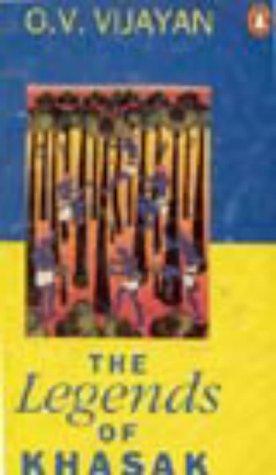
The Legends of Khasak
O. V. Vijayan · 1930–2005 · India (Kerala)
Originally Khasakkinte Itihasam (Malayalam)
Why it matters
A disgraced astrophysics student exiled to a remote Kerala village as its schoolteacher finds his rationalist certainties dissolving into the village's own myth-bound logic. Malayalam fiction's decisive break from social realism into myth, dread, and dreamlike interiority.
At a glance
Dense, allusive prose and a deliberately dreamlike, nonlinear structure resist straightforward plot summary.
Deep dive
A brilliant young scholar runs from one unbearable secret straight into a village that has its own djinns, its own saints, and its own idea of what a schoolteacher is for.
Written for readers who have finished the book. No plot recap, and nothing here is safe to read first.
Themes & symbolism
Ravi arrives in the remote Palakkad village of Khasak already fleeing something the novel only gradually admits outright, an affair with his own stepmother that has made his old life, and his promising path in physics, impossible to return to, and takes up the post of Khasak's first single-teacher school less as a career than as a place to disappear into. Vijayan builds the village almost as a separate cosmology, its own saints, its own djinns, its own memory of a mosque and a mullah who preached a heresy the orthodox never forgave, and Ravi's rationalist, university-trained mind arrives with no authority over any of it.
The prose itself does the absorbing: Vijayan's Malayalam, and the English the novel is known through, mixes folk idiom, invented mythology, and a lyrical, almost hallucinatory register that reads less like realist village fiction than like the village's own dreaming of itself, and critics have credited the novel with remaking what literary Malayalam could sound like. Ravi's slow, unwilled absorption into Khasak's rhythm, he never becomes a believer exactly, but he stops being only an outside observer, happens at the level of sentence and image more than plot.
Maimoona, the young woman Ravi is drawn to without ever quite courting in any conventional sense, gives the novel one more register in which Ravi's outsider status keeps failing to convert into either belonging or a clean departure: his feeling for her stays as suspended and unresolved as everything else about his time in the village, another attachment he can neither properly claim nor properly leave behind.
Appu-Kili and a Teacher Who Can't Fully Teach
Appu-Kili, Ravi's most devoted student, becomes less a pupil than a companion in Ravi's slow surrender of the rationalist authority he arrived with, and the two of them form the novel's real classroom: not the syllabus Ravi is nominally there to deliver, but an ongoing, unresolved negotiation between the village's mythic sense of the world and the scientific one Ravi can no longer fully inhabit himself.
Naizam Ali's Heresy as the Village's Buried History
The story of Naizam Ali, an earlier mullah whose unorthodox teachings still shape how Khasak's Muslims understand their own faith decades later, gives the village a religious history as fractured and contested as any national one, and Vijayan uses it to insist that Khasak's mythic texture isn't ancient folk simplicity handed down unchanged, but the residue of real theological argument, real schism, real loss, still working itself out inside the village's daily life.
The last seal: what actually happens, and why it lands the way it does.
The ending, explained
Having finally decided to leave Khasak, worn down by a transfer notice and by a village that was never going to let him become anything more than a visitor no matter how deep his attachment ran, Ravi waits by the roadside for the bus that will take him away. A snake bites him as he waits. Vijayan doesn't resolve whether the bite is fatal, ending the novel on Ravi's fading awareness of the bus finally arriving, the machine that was supposed to carry him back out into the modern world reaching him just as the ancient, venomous world of Khasak closes over him instead. The image argues, without needing to spell it out, that Ravi was never actually leaving.
Where to go next
 Gabriel García Márquez · 1967One Hundred Years of SolitudeLvl 6Medium pace
 U. R. Ananthamurthy · 1965SamskaraLvl 6Slow burn
 J. M. Coetzee · 1999DisgraceLvl 5Medium pace
 Alejo Carpentier · 1949The Kingdom of This WorldLvl 5Medium pace
 Franz Kafka · 1915The MetamorphosisLvl 4Medium pace
 Dino Buzzati · 1940The Tartar SteppeLvl 5Slow burn