
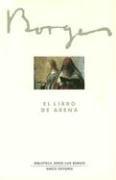
The Book of Sand
Jorge Luis Borges · 1899–1986 · Argentina
Originally El libro de arena (Spanish)
Why it matters
A book with infinitely many pages, a double glimpsed on a park bench, a blind man cataloguing his own vanishing memory. Borges's last major collection, sparer than his 1940s peak but no less vertiginous.
At a glance
Plainer, stripped-down sentences than his earlier work still coil around the same dense paradoxes.
Deep dive
What changes when Borges returns, in his seventies, to the same handful of obsessions with plainer sentences and none of the old encyclopedic scaffolding.
Written for readers who have finished the book. No plot recap, and nothing here is safe to read first.
Themes & symbolism
The title story strips Borges's interest in the infinite down to a single object: a stranger sells the narrator a book with no first or last page, its numbering random and unrepeatable, a Bible-sized object containing, in effect, infinite pages bound between two covers. There's no library this time, no secret society, no elaborate cosmology, just a retired book collector realizing that owning something infinite is closer to a curse than a treasure, since the book can't be read, catalogued, or even safely kept without eventually ruining the life around it. He solves the problem the way a much younger Borges never would have: by hiding the book on a random shelf in the Argentine National Library, where he himself worked for years, and simply choosing not to remember where.
The Congress imagines a secret society trying to build an assembly that would literally represent the entire world, an idea straight out of Borges's earlier fiction, except this version abandons the project once its members realize the world already represents itself perfectly well without their help, a punchline that reads like the older Borges quietly correcting his younger one. The Other stages the writer's most direct self-encounter: an aging Borges meets his own younger self on a park bench in Cambridge, and the two men, sharing a memory and a name but nothing else, can't agree on what year it is or whose life is more real, a conversation that plays as gentler and sadder than any of the doubles and mirrors in his earlier books.
The Same Machinery, Run With the Power Turned Down
Every device here appeared in Borges's books decades earlier: infinite objects, secret societies, a man meeting his own double. What's different in 1975 is the delivery. Ficciones dresses the same ideas in footnotes, invented scholars, and nested narrators; The Book of Sand mostly just tells you what happened, in the voice of an old man who has stopped needing to prove how clever the idea is. The plainness isn't a loss of ambition. It reads more like someone who has spent fifty years building elaborate cages for these obsessions finally deciding the obsession itself is interesting enough without one.
Writing Blind, Two Decades After Going Blind
Borges had been fully blind for nearly twenty years by the time these stories were dictated rather than written, and the collection's spareness owes something to that practical fact as much as to any aesthetic choice: a writer composing in his head, revising by ear, tends to trust the sentence rather than the elaborate architecture around it. The Book of Sand's narrator working at the National Library mirrors Borges's own decades there, a late, plain acknowledgment of how much of his fiction had always been about the specific institution that shaped him, stated here instead of encoded.
Where to go next
 Jorge Luis Borges · 1935A Universal History of InfamyLvl 5Fast paced
 Jorge Luis Borges · 1944FiccionesLvl 7Slow burn
 Jorge Luis Borges · 1949The AlephLvl 7Slow burn
 Julio Cortázar · 1959Blow-Up and Other StoriesLvl 6Medium pace
 Silvina Ocampo · 1959Thus Were Their FacesLvl 5Fast paced
 Adolfo Bioy Casares · 1940The Invention of MorelLvl 5Fast paced