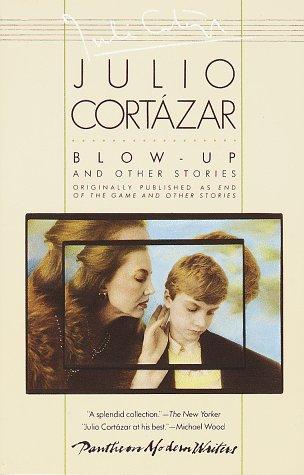
Blow-Up and Other Stories
Julio Cortázar · 1914–1984 · Argentina / France
Originally Blow-Up and Other Stories (Spanish) · translated by Paul Blackburn
Why it matters
Axolotls that stare back, a house slowly taken over, a photograph that keeps developing: the fantastic breaking through Buenos Aires afternoons. Cortázar's stories are the form at its most perfect since Chekhov, by other rules.
At a glance
Surreal ruptures arrive within otherwise tightly controlled, realist short-story form.
Deep dive
How a photograph that seems to keep moving, a house that slowly stops belonging to the people in it, and a man fixated on an axolotl all work through the same doubt about who's really in control of a Cortázar story.
Written for readers who have finished the book. No plot recap, and nothing here is safe to read first.
Themes & symbolism
Blow-Up follows Michel, a translator and amateur photographer, through a small ethical choice, whether to intervene when he photographs a boy he assumes is being lured into a car by an older woman, and turns it into a crisis about what a camera actually captures. Enlarging the print obsessively at home, Michel starts to see the frozen image shift, as though the photograph kept living after the shutter closed and he's now watching, not remembering, a scene he already interrupted once. House Taken Over collapses the same boundary more quietly: a brother and sister alone in their family's ancestral house are pushed, room by room, out of their own home by a presence Cortázar never names, until they lock the door from outside and throw away the key, evicted from an inheritance by something the story refuses to explain.
Axolotl pushes the same idea further: a man who visits the axolotls at the Jardin des Plantes daily, fixated on their motionless golden eyes, ends up narrating from inside one of the tanks, watching his old human self through the glass, unsure whether he's been transformed or simply replaced. Night Face Up runs the reversal through history instead of biology, letting a motorcycle accident patient's fever dream of an Aztec-era manhunt trade places with his hospital bed so completely that which timeline is the dream stops being answerable by the story's end.
Johnny Carter Is Charlie Parker, Not Disguised Very Hard
The Pursuer follows Bruno, a jazz critic writing the biography of Johnny Carter, a saxophonist modeled closely enough on Charlie Parker that Cortázar barely changes the details: the addiction, the erratic genius, solos chasing a version of time the rest of the band can't keep up with. What keeps the story from being a simple roman à clef is Bruno's own discomfort: he needs Carter's chaos to finish a tidy, marketable biography, which makes the story as much an indictment of the critic profiting from genius as a portrait of the genius itself.
Secret Weapons and a Violence That Repeats Itself
Secret Weapons follows Pierre, falling for a woman named Michèle who flinches at things he hasn't done and gets headaches carrying someone else's memories. Cortázar builds toward Pierre reenacting, almost against his will, the actions of a German soldier who once assaulted Michèle during the war, violence resurfacing in a body that wasn't present for the original crime. It's the bluntest statement of a theme the rest of the collection treats more obliquely: how thin the line runs between witnessing an act and repeating it.