
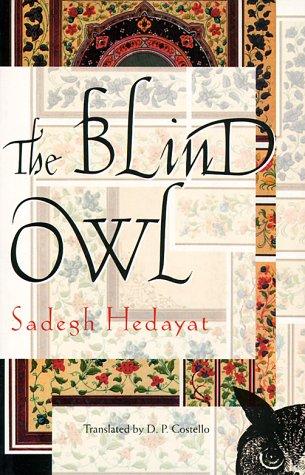
The Blind Owl
Sadegh Hedayat · 1903–1951 · Iran
Originally Buf-e Kur (Persian) · translated by D.P. Costello
Why it matters
An opium-soaked confession to a shadow shaped like an owl: obsession, murder, and recurrence in prose like fever. The masterpiece of modern Iranian fiction, long banned at home, translated everywhere.
At a glance
Hallucinatory, circling narration that dissolves chronology, identity, and reality into one another.
Deep dive
A confession addressed to a shadow rather than a person, told twice in nearly the same words — read it closely and you stop being sure whether its narrator has committed one murder or is doomed to keep committing the same one.
Written for readers who have finished the book. No plot recap, and nothing here is safe to read first.
Themes & symbolism
The novel's two halves circle the same handful of images — the ethereal woman glimpsed once through a small aperture, the cypress tree, the hunched old odds-and-ends dealer, the butcher, a room that keeps being redescribed in slightly altered terms — without ever settling which version is memory, hallucination, repetition, or invention. That refusal is the point: Hedayat structures the book around recurrence rather than causality, so that the narrator's opium-thinned grip on sequence becomes the reader's own. The idealized, silent woman associated with the cypress reappears, transfigured, as a figure closely resembling the narrator's unfaithful wife, and the act of violence he may have committed against her is never allowed to resolve into a single, confirmed event — it recurs instead, restaged under different names and lighting, as though trauma in this book doesn't get remembered so much as relived.
The shadow-owl on the wall, to which the whole confession is addressed, collapses the distance between confessor and judge: the narrator isn't speaking to another person but to a darkened projection of himself, which is also the novel's method in miniature, doubling characters and scenes rather than advancing a plot. Opium, decay, and bodily horror are inseparable from this structure — desire that curdles into violence, a body that rots on the page, a self that can't locate solid ground between waking and drug-addled vision. Hedayat wrote much of this while absorbing European surrealism in Paris, grafting it onto traditional Persian imagery (wine, cypress, miniature-like tableaux), and the result was suppressed for decades in Iran under both the monarchy and the Islamic Republic for its nihilism and sexual frankness even as it became, internationally, the founding text of the modern Persian novel.
The Shadow as Reader
Addressing the confession to a shadow rather than a priest, a lover, or a court does more than set an eerie tone — it removes the possibility of correction. A human listener could challenge the narrator's account, point out contradictions between the two halves, or ask which version really happened; a shadow can only mimic the shape of the one casting it. The novel's authority over its own facts is total and untestable, which is exactly why the two halves are allowed to repeat each other with variations rather than reconcile. Even the narrator's profession — painting the same few images onto pen cases over and over — doubles this logic: he is a man paid to repeat a fixed set of pictures for a living, and the confession he delivers to his own silhouette turns out to repeat itself with the same compulsive, uncanny fidelity.
The last seal: what actually happens, and why it lands the way it does.
The ending, explained
The novel closes by returning to imagery nearly identical to its opening — the same bent figure, the same room, a killing rendered again in language that echoes the earlier one closely enough to suggest this isn't a second event but the same one recurring. Hedayat never confirms whether the narrator has actually murdered anyone, imagined the murder under opium, or is trapped replaying a single unbearable act across shifting names and settings. That irresolution is deliberate: the book ends not on an answer but on the loop closing, the confession arriving back where it started, with the shadow no wiser than when it began listening.
Where to go next
 Franz Kafka · 1915The MetamorphosisLvl 4Medium pace
 Mahmoud Dowlatabadi · 1979Missing SoluchLvl 7Slow burn
 Nawal El Saadawi · 1975Woman at Point ZeroLvl 3Fast paced
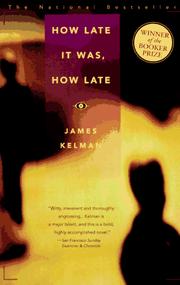 James Kelman · 1994How Late It Was, How LateLvl 7Slow burn
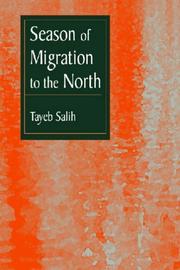 Tayeb Salih · 1966Season of Migration to the NorthLvl 7Slow burn
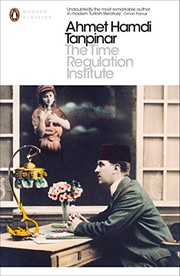 Ahmet Hamdi Tanpınar · 1961The Time Regulation InstituteLvl 7Slow burn