

Sadegh Hedayat
Iran
Feverish and claustrophobic, images and phrases recurring like an opium trance: prose that circles obsession rather than narrating it in a line.
Hedayat came from an aristocratic Tehran family and studied engineering and dentistry in Belgium and France before abandoning both for literature, immersing himself in Kafka, Poe, and Rilke and translating some of the first Kafka into Persian. He returned to Iran to work as a low-level civil servant, chafing against censorship under Reza Shah's government and a literary culture he found provincial.
The Blind Owl (1937), his masterpiece, was initially banned in Iran and circulated privately before finding an audience; its narrator confesses obsession and murder in a hallucinatory, opium-thick voice addressed to a shadow shaped like an owl, collapsing chronology and identity into recurring nightmare. It remains the single most translated and discussed work of modern Persian fiction.
Deeply pessimistic and increasingly isolated, Hedayat traveled to Paris in 1951 and took his own life there that same year, sealing his apartment and destroying unpublished manuscripts before he died.
Lines of influence
No descendants recorded, yet.
Their books in the atlas
- 1937
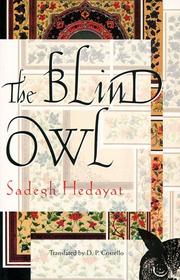 The Blind OwlLvl 8gothic
Meanwhile, elsewhere
 1875–1955Thomas MannGermanyWestern Europe · Germany
 1873–1954ColetteFranceWestern Europe · France
 1869–1951André GideFranceWestern Europe · France
 1896–1957Giuseppe Tomasi di LampedusaItalyWestern Europe · Italy
 1879–1970E. M. ForsterEnglandWestern Europe · England
 1903–1966Evelyn WaughEnglandWestern Europe · England
If you like Hedayat, try
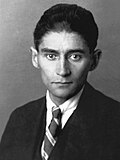 1883–1924Franz KafkaCzechia (Bohemia)shaped Hedayat · kindred genres: existentialist, psychological novel
 b. 1940Mahmoud DowlatabadiIranshared movement: Arabic & Middle Eastern Modern · both write in Persian · same region & era
 1931–2021Nawal El SaadawiEgyptshared movement: Arabic & Middle Eastern Modern · kindred genres: psychological novel · same region & era
 b. 1946James KelmanScotlandboth shaped by Kafka · kindred genres: existentialist, psychological novel
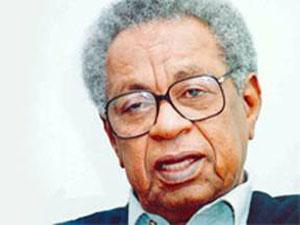 1929–2009Tayeb SalihSudanshared movement: Arabic & Middle Eastern Modern · kindred genres: psychological novel
 1901–1962Ahmet Hamdi TanpınarTurkeyshared movement: Arabic & Middle Eastern Modern · same region & era