
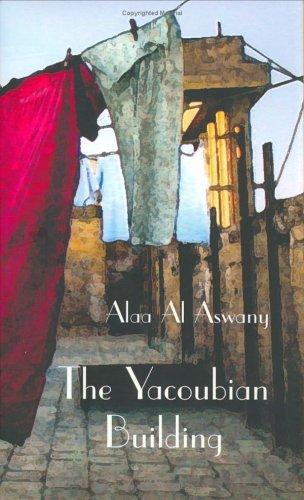
The Yacoubian Building
Alaa Al Aswany · b. 1957 · Egypt
Originally Imarat Ya'qubian (Arabic) · translated by Humphrey Davies
Why it matters
A closeted editor, a corrupt businessman, and a radicalized doorman's son all live inside one crumbling downtown Cairo building. The bestselling Arabic novel of its decade, mapping Egyptian society's fractures under Mubarak.
At a glance
Multiple interwoven plotlines but told in brisk, accessible, journalistic prose.
Deep dive
A crumbling downtown Cairo apartment block holds a communist doorkeeper's son turned religious radical, a closeted newspaper editor, and an aging aristocrat still chasing the Cairo he remembers from before the monarchy fell, and the building's residents spend the novel proving how little separates their private compromises from Egypt's public ones.
Written for readers who have finished the book. No plot recap, and nothing here is safe to read first.
Themes & symbolism
The Yacoubian Building itself, a once-grand downtown Cairo apartment block built in the 1930s and now housing everyone from old-money holdouts in its apartments to poor families crowded into makeshift rooms on its roof, gives Al Aswany a single physical structure sturdy enough to hold Egypt's entire class system without needing to leave the premises. Zaki Bey el Dessouki, Paris-educated, aging, still dressing and flirting like the monarchy never fell, occupies the building's ground floor as a living relic of a more cosmopolitan Cairo, while Taha el Shazli, the doorkeeper's son, studies desperately for the police academy exam just downstairs, in a class gap the novel refuses to treat as merely backdrop.
Taha's rejection from the police academy, made purely on the grounds of his father's menial job rather than his own qualifications, becomes the novel's clearest engine for radicalization: humiliated by the secular state's own gatekeeping, he drifts toward an Islamist movement that offers him the dignity Egypt's institutions withheld, and Al Aswany traces that pipeline, ordinary grievance into extremism, without flattening Taha into either victim or villain.
Hatim Rasheed, a wealthy, French-educated newspaper editor, conducts a closeted relationship with Abduh, a poor conscript soldier, in a novel that gives their affair the same emotional seriousness it gives every heterosexual relationship in the building, a genuinely rare choice for mainstream Arabic fiction in 2002. Al Aswany refuses Hatim a straightforward tragic arc even as the novel does eventually punish the relationship, using Hatim's story less to make a single point about homosexuality than to add one more form of enforced secrecy to a building already built on so many others: political, sexual, financial.
Hagg Azzam's Second Marriage as Corruption's Paper Trail
Hagg Azzam, a former shoeshine boy turned drug-money millionaire angling for a seat in parliament, takes a secret second wife purely to keep his hidden sexual appetite from threatening his public image as a respectable, newly religious businessman, then abandons her the moment she becomes pregnant because a child would make the secret marriage impossible to keep hidden from the state security apparatus he depends on for his parliamentary seat. Al Aswany uses that entire subplot to show how thoroughly corruption in Egypt reaches into the most private arrangements, sex, marriage, family, not merely into contracts and elections.
The last seal: what actually happens, and why it lands the way it does.
The ending, explained
Taha, radicalized fully after imprisonment and torture at the hands of state security, joins an armed cell and dies in a shootout after assassinating the officer who tortured him, his path from rejected police cadet to political violence completed exactly along the line the novel has been tracing since his university days. Hatim is killed by Abduh, who turns on him in a fit of shame and rage after Abduh's own infant son dies and he comes to see the affair as the sin responsible for his family's suffering. Zaki Bey, alone among the major characters, gets something like a happy ending: he ends up with Busayna, the young woman who has spent the novel fending off men who see her poverty as an opening, and the two of them retreat into the building's remaining old-world comforts. Al Aswany closes on that contrast deliberately, wealth and old connections buying Zaki an ending violence and poverty deny everyone else in the building.
Where to go next
 Alaa Al Aswany · 2007ChicagoLvl 4Medium pace
 Alaa Al Aswany · 2013The Automobile Club of EgyptLvl 5Medium pace
 Naguib Mahfouz · 1956Palace WalkLvl 4Medium pace
 Elias Khoury · 1998Gate of the SunLvl 7Slow burn
 Ghassan Kanafani · 1963Men in the SunLvl 5Medium pace
 Nawal El Saadawi · 1975Woman at Point ZeroLvl 3Fast paced