
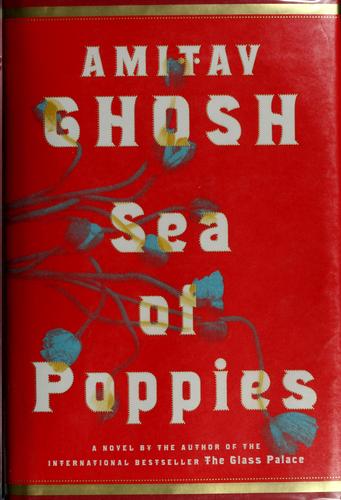
Sea of Poppies
Amitav Ghosh · b. 1956 · India
Why it matters
On the eve of the First Opium War, an indentured widow, a bankrupt raja, a mixed-race sailor, and a runaway all converge aboard the ship Ibis, bound from Calcutta to Mauritius. The first, most maximalist volume of Ghosh's Ibis trilogy.
At a glance
A vast ensemble cast and dense period argot, Lascari slang folded into Bhojpuri-inflected English, slow the opening chapters.
Deep dive
A ship of indentured laborers, a fugitive raja, and a mixed-race sailor passing as white all converge on the Ibis bound for Mauritius, and Ghosh spends the whole crossing showing how completely the opium trade has already scrambled caste, race, and nationality before the ship even clears the Bay of Bengal.
Written for readers who have finished the book. No plot recap, and nothing here is safe to read first.
Themes & symbolism
Deeti's opening vision, a tall-masted ship she's never seen appearing to her in the Ganges plain, sets up the Ibis as the novel's central engine, a former slave ship repurposed to carry indentured labor, girmitiyas, to Mauritius after Britain's opium economy has wrecked the poppy-growing districts that once sustained her own village and family.
Shipboard hierarchy is the novel's real subject: a raja stripped of his fortune, a Chinese-American opium addict, a French orphan raised as a Bengali, a low-caste strongman, and an American sailor passing as white are sorted into a single hold, where the fixed categories of caste, race, and nationality that organized their lives on land collapse into a shared and much more fluid identity, jahaz-bhai, ship-siblings, that the girmitiyas invent for one another en route.
Ghosh's dense, specific vocabulary, pidgin, Bhojpuri, lascar shipboard slang, folded largely untranslated into the prose, does more than color the setting: it insists the reader do the same work of cultural translation the characters are doing, refusing the comfort of a single linguistic frame for an ocean this crowded with different histories.
The Opium Economy Behind the Girmitiya Ships
British-enforced poppy cultivation across Bihar, grown for the Chinese opium trade at the expense of food crops, drives indebted farmers like Deeti's own family into indentured labor as a form of economic exile, directly linking Sea of Poppies to the same trade that triggers the First Opium War dramatized later in the trilogy.
Jahaz-Bhai: A Kinship Invented on Board
Stripped of caste distinctions once they cross the kala pani, the black water believed to erase caste standing, the girmitiyas invent the term jahaz-bhai, ship-sibling, to describe a new, chosen family that supersedes the ones they left, a bond the trilogy's later volumes keep testing against distance, wealth, and time.
A Cliffhanger by Design
Ghosh ends the crossing mid-storm, with Neel, Ah Fatt, Jodu, Serang Ali, and Kalua stealing a longboat toward Singapore while Deeti, Paulette, and Zachary carry on toward Mauritius aboard the Ibis itself, and the split is the whole point of writing a trilogy this way: Sea of Poppies isn't withholding a resolution, it's ending exactly where a single ship's voyage runs out, on the understanding that River of Smoke and Flood of Fire pick up threads this book was never going to tie off on its own.
Where to go next
 Amitav Ghosh · 1988The Shadow LinesLvl 7Slow burn
 Amitav Ghosh · 1992In an Antique LandLvl 5Slow burn
 Amitav Ghosh · 2000The Glass PalaceLvl 4Medium pace
 Amitav Ghosh · 2004The Hungry TideLvl 4Medium pace
 Salman Rushdie · 1981Midnight's ChildrenLvl 8Medium pace
 Vikram Seth · 1993A Suitable BoyLvl 3Medium pace