
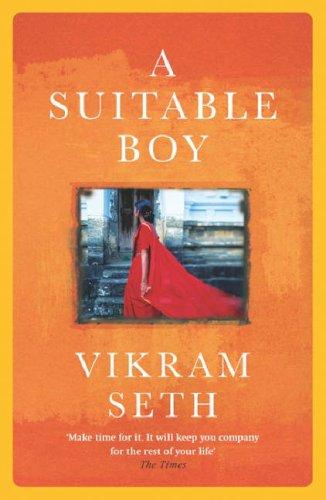
A Suitable Boy
Vikram Seth · b. 1952 · India
Why it matters
A mother's search for the right husband for her daughter unfolds across newly independent India's politics, religion, and romance. One of the longest novels ever published in English, and a warm, Trollope-scaled panorama of a nation finding its feet.
At a glance
Plainly told and linear; its challenge is sheer length and a vast cast, not prose difficulty.
Deep dive
Four families, four possible husbands, and the vast post-independence India Vikram Seth builds around one mother's single-minded search for a groom her daughter never asked for.
Written for readers who have finished the book. No plot recap, and nothing here is safe to read first.
Themes & symbolism
Mrs. Rupa Mehra's hunt for a groom for her daughter Lata organizes thirteen hundred pages around what looks like the smallest possible plot, and Seth uses that scale deliberately: the marriage market becomes the lens through which the whole apparatus of a two-year-old republic gets examined, from Mahesh Kapoor's Zamindari Abolition Bill breaking up feudal landholding to the first general election's chaotic machinery. Lata's three suitors, the poet Amit, the shoemaker-industrialist Haresh, and the Muslim student Kabir, aren't just romantic options. Each one is also a different vision of what modern India should reward: English literary sophistication, practical commercial competence, or a love the country's own new communal fault lines make close to impossible.
The Kapoor and Mehra households' religious mixing runs directly against the novel's other major thread, a Ram Navami procession and a mosque dispute colliding into a riot after political manipulation turns a scheduling conflict into a crisis. Seth keeps insisting that private choices, who a family lets its daughter love, carry public weight in a country still working out what secularism actually requires of its citizens, and Maan Kapoor's ruinous affair with the courtesan Saeeda Bai runs that same argument through desire rather than doctrine, since it costs him his father's political standing along with his own.
A Realist Novel Built at Trollope's Scale, on Purpose
Seth wrote A Suitable Boy as old-fashioned, capacious social realism modeled on Trollope and Tolstoy rather than on his own modernist contemporaries, at a length that was itself a statement: after decades of postcolonial fiction straining toward formal experiment, Seth bet that the nineteenth-century social novel, four intermarried families, a marriage plot, room for subplots on land reform and shoe manufacturing, was still the better instrument for a country this large and this interconnected.
The Zamindari Bill as a Second Marriage Plot
Mahesh Kapoor's legislative fight to abolish zamindari landholding runs on a clock parallel to Lata's courtship, and Seth cuts between them so the reader tracks two processes of dispossession and redistribution at once, land changing hands in Parliament, a daughter's hand being negotiated at home, until the novel's two plots start to look like the same story about who gets to hold power in the new India and on what terms.
The last seal: what actually happens, and why it lands the way it does.
The ending, explained
Lata chooses Haresh, the pragmatic shoe-trade professional her mother has been steering her toward from the start, over Amit's literary charm and a relationship with Kabir that religious difference made impossible to sustain. It reads less as romantic defeat than as Seth's considered argument for the marriage: Haresh is competent, kind, and unglamorous in exactly the ways the novel has spent a thousand pages suggesting actually sustain a life, against Amit's self-absorption and a match neither family's community would have accepted. Around her wedding, Mahesh Kapoor's bill finally passes into law and Maan slowly rebuilds his father's trust after his affair's fallout, so the marriage plot's quiet resolution lands alongside the political one, both suggesting that the new republic's future depends on unglamorous, practical settlements rather than grand romantic or ideological gestures.
Where to go next
 Vikram Seth · 1986The Golden GateLvl 6Fast paced
 Aravind Adiga · 2008The White TigerLvl 4Fast paced
 Amitav Ghosh · 1988The Shadow LinesLvl 7Slow burn
 Kiran Desai · 2006The Inheritance of LossLvl 6Slow burn
 Salman Rushdie · 1981Midnight's ChildrenLvl 8Medium pace
 Ama Ata Aidoo · 1991ChangesLvl 3Medium pace