
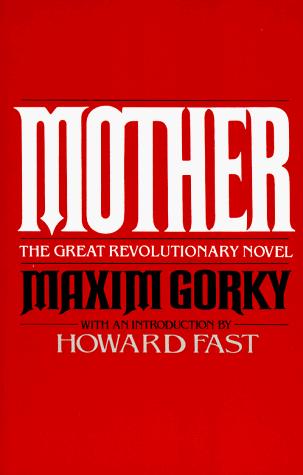
Mother
Maxim Gorky · 1868–1936 · Russia
Originally Mat (Russian)
Why it matters
A factory worker is radicalized into revolutionary politics by her son's imprisonment for organizing. The template novel for decades of Socialist Realism to come, prized by the Soviet state above all Gorky's other work.
At a glance
Direct, didactic realist prose built for accessibility and propagandistic clarity.
Deep dive
An old, devout, politically unremarkable widow becomes a revolutionary through her son's underground organizing — and the novel's real interest is in what happens when traditional maternal devotion gets redirected toward a cause instead of a household.
Written for readers who have finished the book. No plot recap, and nothing here is safe to read first.
Themes & symbolism
Pelageya Nilovna spends decades accepting her drunken, abusive husband's violence as simply how life is; her transformation, once her son Pavel's underground socialist organizing draws her in, isn't a rejection of her old values so much as a redirection of them; Gorky explicitly reframes devotion, sacrifice, and faith not as obstacles to radical politics but as its emotional raw material, and Nilovna's love for Pavel becomes, by the novel's design, a metonym for a broader, class-conscious love for the whole community of workers. Her usefulness to the movement depends on the very invisibility that patriarchal and religious society assigned her: an old woman beneath official suspicion can smuggle banned pamphlets past guards who don't expect a devout mother to be a political operative, turning the condescension aimed at her into cover.
Gorky, a close Bolshevik associate at the time of writing, builds the novel as explicit propaganda and pedagogy rather than ambivalent art, and its moral universe is correspondingly uncomplicated: workers are essentially good and awakening, factory owners and police essentially corrupt and doomed. That didactic clarity — the deliberate inversion of who gets to be a revolutionary hero, an old religious woman rather than a young intellectual — is precisely what later made the novel the founding template for Socialist Realism, the style the Soviet state would impose on its writers for decades; its literary interest today is inseparable from that historical afterlife.
Gorky wrote much of the novel while living in the United States on a fundraising trip for the Bolshevik cause, publishing it first in English translation before its Russian release, a detail that underscores how consciously the book was conceived as an international organizing tool rather than simply a work of national literature aimed at Russian readers alone. Soviet critics later treated Nilovna's arc as a virtual instruction manual, and generations of officially sanctioned novels borrowed its central move of locating revolutionary consciousness in the most conventionally powerless figure the culture could imagine.
The last seal: what actually happens, and why it lands the way it does.
The ending, explained
After Pavel is tried and sentenced to Siberian exile, delivering a defiant courtroom speech intended to circulate as revolutionary propaganda, Nilovna takes up the task of distributing printed copies of that speech herself, fully committed now to the cause her son awakened her to. Arrested at a train station in the act, she is beaten by police in public and responds not by submitting but by continuing to shout the revolutionary message to the crowd gathered around her. Gorky closes on this image of physical suffering transmuted directly into political triumph, Nilovna's arc from passive endurance to active revolutionary voice presented as complete and irreversible — offered as an inspirational model rather than a tragedy, in keeping with the novel's entirely unambivalent design.
Where to go next
 Maxim Gorky · 1913My ChildhoodLvl 4Medium pace
 Mikhail Sholokhov · 1928And Quiet Flows the DonLvl 5Medium pace
 Aleksandr Solzhenitsyn · 1962One Day in the Life of Ivan DenisovichLvl 3Fast paced
 Leo Tolstoy · 1878Anna KareninaLvl 5Medium pace
 Boris Pasternak · 1957Doctor ZhivagoLvl 6Slow burn
 Vasily Grossman · 1980Life and FateLvl 7Medium pace