
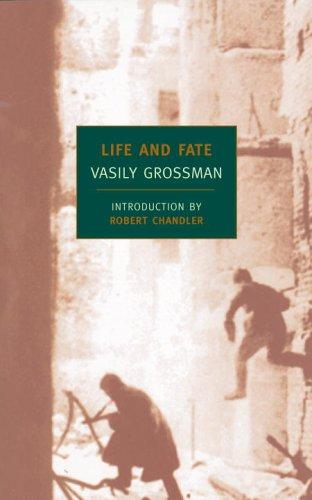
Life and Fate
Vasily Grossman · 1905–1964 · Ukraine / Russia
Originally Zhizn i Sudba (Russian) · translated by Robert Chandler
Why it matters
Stalingrad, the Shoah, and the Gulag in one Tolstoyan canvas, with the forbidden thesis that the two totalitarianisms mirrored each other. The KGB 'arrested' the manuscript; a smuggled microfilm saved the century's great Russian novel.
At a glance
Enormous cast across many fronts and essayistic passages on totalitarianism demand sustained tracking.
Deep dive
Why a single chapter set inside a gas chamber sits in the same novel as a purge interrogation — and why the connection Grossman drew between them was the part the Kremlin couldn't survive.
Written for readers who have finished the book. No plot recap, and nothing here is safe to read first.
Themes & symbolism
The novel's structure does the arguing that its characters can't safely do aloud: chapters set in a German extermination camp sit adjacent to chapters set in a Soviet interrogation cell, the same vocabulary of dehumanization — forms, numbers, the bureaucratic erasure of a name — surfacing in both, so that the reader assembles the equivalence Grossman couldn't state as bald political argument without ensuring the book's destruction. Totalitarian language itself becomes a symbol: the euphemisms of the camp administrator and the euphemisms of the NKVD interrogator are shown to be dialects of the same tongue. Grossman doesn't flatten the two systems' crimes into sameness — the Holocaust's exterminatory intent and the Gulag's differ — but insists both machines require the same act from their functionaries: the surrender of an individual's moral particularity to an abstraction (race, class, the Party) that makes killing or betrayal administratively simple.
Viktor Shtrum carries the novel's conscience plot: a physicist whose genuinely important discovery becomes a target the moment Soviet antisemitism and ideological policing decide his Jewishness and his science's implications are inconvenient, and who eventually signs a denunciation letter he doesn't believe in order to save his position, a single act of capitulation Grossman refuses to either excuse or melodramatize. Around him, the Shaposhnikov family and dozens of soldiers, officers, and camp inmates supply the Tolstoyan breadth Grossman was explicitly reaching for — a whole society, not a single tragic hero, rendered under totalitarian pressure from both directions of the war. Even the novel's soldiers at Stalingrad, ostensibly the site of the book's one uncomplicated heroism, are shadowed by political commissars alert for defeatist talk, so that courage under German fire and caution under Soviet suspicion turn out to require the same constant, exhausting vigilance.
The Gas Chamber Chapter
One chapter, narrating a mother and son's final minutes inside a Nazi gas chamber, is written with a directness almost unprecedented in Soviet-era fiction, refusing both euphemism and spectacle, holding to small physical and emotional detail until the moment the narration itself has nowhere left to go. Grossman had reported on Treblinka as a wartime journalist, and his own mother was murdered by the Nazis in Berdichev; the chapter carries that lived, specific grief rather than abstracted horror, and it's the moment the novel's argument about dehumanization becomes unbearably concrete rather than merely structural.
A Second War and Peace
Grossman modeled the novel's scale and ambition openly on Tolstoy — multiple interlinked families, a national crisis (Stalingrad standing in for 1812), long discursive passages on history and free will — but where Tolstoy's Russia ultimately vindicates itself through the war, Grossman's doesn't: the same state whose citizens win at Stalingrad continues arresting, interrogating, and disappearing its own people throughout the novel, without pause or contradiction. The Tolstoyan form becomes, in Grossman's hands, a vehicle for an anti-triumphalist argument Tolstoy never had to make.
The last seal: what actually happens, and why it lands the way it does.
The ending, explained
The novel converges its threads not on a single climax but on the Soviet victory at Stalingrad, which Grossman deliberately refuses to render as resolution: the state's machinery of surveillance and denunciation doesn't loosen because the war is being won, and several characters remain caught in or newly ensnared by it even as the front moves west. Shtrum, having capitulated to sign the letter, is left morally uneasy in the very moment his position is restored — vindication and self-betrayal arrive together. Grossman's closing note is that defeating Nazism proved nothing about the character of the system that defeated it, and did nothing to loosen its grip on the people who'd just won.
Where to go next
 Vasily Grossman · 1961Everything FlowsLvl 6Slow burn
 Mikhail Sholokhov · 1928And Quiet Flows the DonLvl 5Medium pace
 Anton Chekhov · 1899Selected StoriesLvl 4Medium pace
 Aleksandr Solzhenitsyn · 1962One Day in the Life of Ivan DenisovichLvl 3Fast paced
 Boris Pasternak · 1957Doctor ZhivagoLvl 6Slow burn
 Leo Tolstoy · 1878Anna KareninaLvl 5Medium pace