
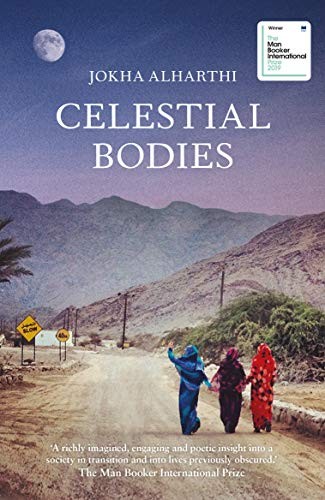
Celestial Bodies
Jokha Alharthi · b. 1978 · Oman
Originally Sayyidat al-Qamar (Arabic) · translated by Marilyn Booth
Why it matters
Three sisters in an Omani village navigate marriage, loss, and a society transforming from slaveholding tradition into oil-age modernity, the story circling between more than a dozen narrators rather than marching forward. The first Arabic-language novel to win the International Booker Prize.
At a glance
Nonlinear structure with a large cast of shifting narrators requires close tracking of who is speaking.
Deep dive
Three sisters in one Omani family choose three different ways to survive a marriage market that is also, one generation removed, still working out what to do with the people it used to own outright.
Written for readers who have finished the book. No plot recap, and nothing here is safe to read first.
Themes & symbolism
Mayya, Asma, and Khawla each negotiate the same narrowing set of options differently. Mayya marries Abdallah without love, absorbed instead in the sewing machine that gives her something of her own, and names her first daughter London after nothing more than the sound of the word. Asma marries out of calculation, treating the wedding as a door out of a suffocating household rather than a romance. Khawla refuses every suitor her family produces, waiting years for a cousin who emigrated to Canada and barely writes back. Alharthi lets all three count as forms of agency and constraint at once, none of them clean escapes.
Running underneath the sisters' story is Zarifa, once enslaved in the household and, even after Oman's formal abolition of slavery in 1970, still bound to it by something the family never quite calls debt and never quite calls love. Her son occupies a status the novel refuses to simplify, freeborn on paper and unequal in practice, and Alharthi uses that lingering asymmetry to insist abolition was a date on a law, not an ending.
The novel's chapters skip between narrators and decades without signposting, anchored only by Abdallah's first-person sections, narrated mid-flight to Frankfurt, which return obsessively to his father Sulayman's dealings and his own uneasy fatherhood. That structure enacts, formally, the same compression the book describes historically: a society that moved from camel caravans and household slavery to oil wealth and international flights within a single lifetime, with no interval long enough to properly absorb the distance travelled.
Zarifa and the Ledger of Who Is Owned
Zarifa's position in the household after manumission looks, on the surface, like belonging: she runs the kitchen, raises the children, is scolded and confided in like family. Alharthi keeps returning to the smaller marks of what that belonging actually costs, whose name appears on which document, whose marriage is arranged by whom, whose grief is allowed to interrupt the household's routine and whose is expected to serve it. The novel's argument is not that slavery persisted after 1970 in name, but that its habits of ownership survived quietly inside the very intimacy that was supposed to have replaced it.
Abdallah's Flight: A Structure With No Landing
Every one of Abdallah's chapters is narrated from the same cramped airplane seat, memory arriving in no particular order as the plane crosses one time zone after another. Alharthi never lets him land inside his own narration, so his reckoning with his father's history and his own failures as a husband and parent stays permanently mid-transit, unresolved by the time the aircraft, and the novel, eventually touches down. The device denies the reader the comfort of a single vantage point from which the family's whole story finally makes sense.
Where to go next
 Alaa Al Aswany · 2002The Yacoubian BuildingLvl 4Fast paced
 Naguib Mahfouz · 1956Palace WalkLvl 4Medium pace
 Nawal El Saadawi · 1975Woman at Point ZeroLvl 3Fast paced
 Tayeb Salih · 1966Season of Migration to the NorthLvl 7Slow burn
 Mieko Kawakami · 2019Breasts and EggsLvl 4Slow burn
 Wang Anyi · 1995The Song of Everlasting SorrowLvl 6Slow burn