
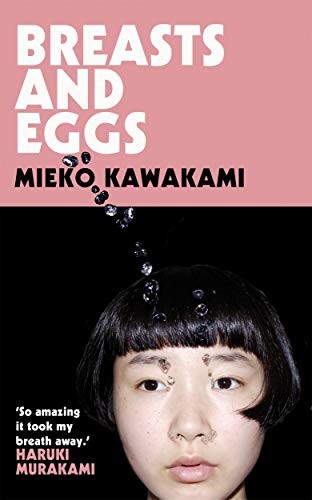
Breasts and Eggs
Mieko Kawakami · b. 1976 · Japan
Originally Natsu Monogatari (Japanese) · translated by Sam Bett and David Boyd
Why it matters
A single mother, her daughter, and her sister's fixation on breast augmentation surgery collide over one Tokyo summer. Class, motherhood, and bodily autonomy examined with unusual directness for Japanese letters.
At a glance
Two-part structure with shifting timeframes and long interior monologue passages.
Deep dive
What a sister's fixation on breast implants and a niece who has stopped speaking have to do, years later, with one woman's decision to try to have a child entirely on her own terms.
Written for readers who have finished the book. No plot recap, and nothing here is safe to read first.
Themes & symbolism
Book One puts two versions of bodily anxiety in the same small Tokyo apartment and refuses to rank them. Makiko, aging out of hostess work in Osaka and terrified of what that means for her income and her sense of being looked at, has fixated on breast augmentation with a specificity that reads as desperate rather than vain, researching implant brands and surgeons the way someone else might research a diagnosis. Her daughter Midoriko has stopped speaking entirely and communicates only through a notebook, horrified by her own approaching puberty and, more particularly, by the mechanics of conception itself, which she records with a disgust that Kawakami never lets tip into cute precociousness. Natsuko, the narrator, sits between them taking notes of her own, a writer's habit that will matter more later than it seems to here.
Book Two jumps years ahead and turns Midoriko's childhood horror into an adult question asked from the opposite direction: not whether a child should have to consent to being conceived, but whether a woman without a partner has any legitimate way to conceive on purpose. Natsuko, now a published novelist and single, pursues donor insemination and finds herself talking at length with Aizawa, a donor-conceived man who has spent his adult life campaigning for donor-conceived people's right to know their genetic origins, a right Japan's clinics have historically been happy to ignore. Kawakami lets Aizawa's argument land with real force without ever letting it settle Natsuko's decision for her.
Midoriko's Notebook
Midoriko's silence is never coy; it reads as genuine refusal, aimed less at her mother than at a body that keeps changing without asking her anything first. Her notebook entries fixate on eggs, literal and reproductive, with a squeamishness that the novel treats as entirely reasonable rather than as a phase to be outgrown. What makes the device work is that Kawakami never has an adult explain Midoriko's feelings back to her in tidier language. The notebook stays hers, unglossed, and the reader is left to sit with a child's disgust at inheriting a body built for a use she never agreed to.
The Novella Kawakami Rewrote Around
Book One began as a much shorter, self-contained novella that won the Akutagawa Prize in 2008, championed publicly by Haruki Murakami as proof of a genuinely new voice in Japanese fiction. Kawakami returned to that material more than a decade later and built Book Two around it rather than simply extending the plot forward, a structural choice that lets the finished novel read less like a sequel than like an adult argument staged in direct response to a child's earlier one. Kawakami has spoken about her own path to single motherhood by donor conception, which gives Natsuko's chapters a specificity that never tips into memoir dressed as fiction.
The last seal: what actually happens, and why it lands the way it does.
The ending, explained
Natsuko pursues and completes donor insemination on her own, working through the practical and ethical difficulty of doing so in a system built to discourage exactly this, and Aizawa's warnings about a donor-conceived child's eventual right to answers stay with her rather than talking her out of anything. The birth that follows is rendered without triumph or apology, closer to the plain, physical register Kawakami used for Makiko's surgery and Midoriko's fear years earlier than to any conventional happy ending. What closes the novel is less a resolution than a continuation: Natsuko choosing, deliberately and with open eyes about the cost, the same female biological work that Book One's women had mostly endured rather than chosen.
Where to go next
 Sayaka Murata · 2016Convenience Store WomanLvl 2Fast paced
 Banana Yoshimoto · 1988KitchenLvl 2Medium pace
 Yōko Ogawa · 1994The Memory PoliceLvl 4Slow burn
 Haruki Murakami · 1987Norwegian WoodLvl 3Fast paced
 Kenzaburō Ōe · 1964A Personal MatterLvl 5Medium pace
 Osamu Dazai · 1948No Longer HumanLvl 4Medium pace