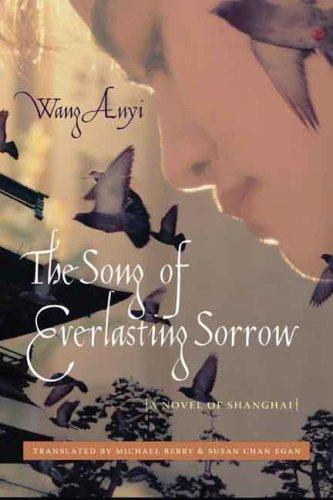
The Song of Everlasting Sorrow
Wang Anyi · b. 1954 · China
Originally Chang Hen Ge (Chinese) · translated by Michael Berry and Susan Chan Egan
Why it matters
A 1940s Shanghai beauty-pageant runner-up survives four decades of Communist rule, the Cultural Revolution, and the city's reopening, her doomed love affairs set against alleyway gossip and vanished glamour. Contemporary Chinese fiction's great elegy for old Shanghai.
At a glance
Dense domestic detail and a slow, accumulating pace trade momentum for atmosphere across four decades.
Deep dive
Why a beauty pageant's third-place ribbon becomes the single measure Wang Qiyao holds herself to for the next four decades, no matter how much of Shanghai changes underneath her.
Written for readers who have finished the book. No plot recap, and nothing here is safe to read first.
Themes & symbolism
Wang Qiyao wins nothing, technically. Third place in the 1946 Miss Shanghai pageant, 'Miss Third Place,' a runner-up title behind two other young women whose names the novel barely bothers to remember, becomes nonetheless the defining hour of her life, and Wang Anyi spends the next four decades tracking exactly how a woman keeps performing a moment of validation the world has otherwise stopped watching. Through the Communist takeover, the political campaigns of the 1950s, the Cultural Revolution's worst years, and Shanghai's eventual reopening, Wang Qiyao's private measuring stick never updates; she keeps dressing, entertaining, and arranging her rooms as though the pageant's judges were still in the building.
The longtang, Shanghai's dense, gossip-thick residential alleyways, function in the novel as a kind of second protagonist, patient, watchful, and largely indifferent to the historical convulsions passing overhead. Wang Anyi opens with an extended, almost architectural meditation on the longtang before Wang Qiyao ever appears, and that ordering matters: her heroine's private glamour, her affair with a Party official identified mostly by his title, her later relationships, all play out inside a social fabric that keeps its own rhythms of mahjong games and rumor regardless of which political campaign officially governs the era outside.
Old Colour, and the Decade Each of Them Is Really Chasing
Deep into the novel's final section, set in the 1980s, a middle-aged Wang Qiyao begins an affair with a much younger man the text calls Old Colour, a nickname that already carries a joke about someone play-acting an antique sophistication he hasn't earned. Wang Anyi stages the relationship less as scandal than as elegy: Wang Qiyao is chasing, one more time, the specific attention that made her Miss Third Place, and Old Colour is chasing an idea of old Shanghai glamour he's too young to have actually witnessed, so both of them are courting a fantasy of the other's decade rather than the person actually in the room. When the relationship dissolves, it takes with it the last version of Wang Qiyao's youth she has any hope of restaging.
The last seal: what actually happens, and why it lands the way it does.
The ending, explained
A con man called Long Legs, aware that Wang Qiyao has kept a stash of gold bars since the 1940s, payment, decades earlier, from the Party official who kept her as his mistress, targets her for the money rather than for anything resembling affection. Cornered and refusing to hand the gold over, she is killed in her own longtang apartment, her body found only after the fact. Wang Anyi structures the death to rhyme deliberately with an earlier scene from Wang Qiyao's youth, a film shoot she once witnessed staging a woman's murder for the camera, so that the novel's actual ending finally puts a woman's real death in the same room as the glamorous performance of death she'd once watched as a girl and never quite stopped auditioning for.