
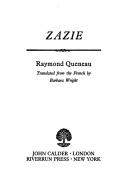
Zazie in the Metro
Raymond Queneau · 1903–1976 · France
Originally Zazie dans le métro (French)
Why it matters
A foul-mouthed twelve-year-old runs loose across a single manic Paris day while the Metro she wants to ride stays shut for a strike. Slapstick, wordplay, and formal cunning collide in one of French comedy's most beloved novels.
At a glance
Dense wordplay and phonetic spelling make the French slippery in translation.
Deep dive
A foul-mouthed twelve-year-old runs loose across Paris for a single day, and the nonstop talk swirling around her keeps insisting that talk and action are not the same thing.
Written for readers who have finished the book. No plot recap, and nothing here is safe to read first.
Themes & symbolism
Queneau opens on a phonetic assault — "Doukipudonktan," a squashed transliteration of "D'où qu'ils puent donc tant" (where's that awful smell coming from) — and keeps writing in that register throughout: spoken French rendered as it sounds rather than as the academy spells it, Rabelaisian slang colliding with tourist-brochure formality, grammar treated as something to be performed rather than obeyed. The novel is doing on the page what Zazie does in the streets: refusing the adult world's insistence on correct, orderly forms, whether that's proper spelling or a functioning Metro.
Gabriel — Zazie's uncle, a nightclub performer whose act and private manner drift between masculine and feminine registers without the novel ever bothering to pin down which is the "real" him — gets treated with total nonchalance amid the surrounding chaos of widows, fake widowers, and baffled tourists, refusing to resolve into a stable identity just as the prose refuses to resolve into stable spelling. The parrot Laverdure's refrain, "Tu causes, tu causes, c'est tout ce que tu sais faire" (you talk and talk, that's all you're good for), becomes the novel's own verdict on its cast: a city of virtuoso talkers — flirts, guides, con artists, quarreling adults — whose torrents of language mostly generate slapstick rather than anything actually getting resolved.
An Untranslatable Text
Queneau's phonetic spelling and slang made the novel notoriously resistant to translation; Barbara Wright's 1960 English version is celebrated in its own right for inventing an equivalent register of English mangling — "Howcanaystinksotho" for the opening line — rather than attempting a literal rendering, effectively writing a parallel comic text instead of a translation. Queneau, a founding figure of the Oulipo group with its taste for formal constraint and wordplay-as-method, treats the strike-shuttered Metro less as a plot obstacle than as a structural joke: the one piece of Parisian order Zazie actually wants access to is the single thing the novel withholds start to finish.
The last seal: what actually happens, and why it lands the way it does.
The ending, explained
The Metro strike that has thwarted Zazie's one stated wish all day ends just as she's leaving Paris, exhausted and asleep, having caused a day of citywide chaos without ever once riding the train she came for. Reunited with her mother and asked what she did in the city, Zazie answers, flatly, "J'ai vieilli" — I got older. The deadpan non-answer refuses both the adventure-story payoff (the ride she wanted) and any tidy moral, landing instead on comic deflation: a day of anarchic incident compressed into a shrug, which is exactly the register the whole novel has been working in.
Where to go next
 Raymond Queneau · 1947Exercises in StyleLvl 5Fast paced
 Georges Perec · 1978Life A User's ManualLvl 8Slow burn
 Italo Calvino · 1972Invisible CitiesLvl 5Slow burn
 André Gide · 1902The ImmoralistLvl 5Medium pace
 Marcel Proust · 1913Swann's WayLvl 8Slow burn
 Laurence Sterne · 1759The Life and Opinions of Tristram Shandy, GentlemanLvl 9Slow burn