
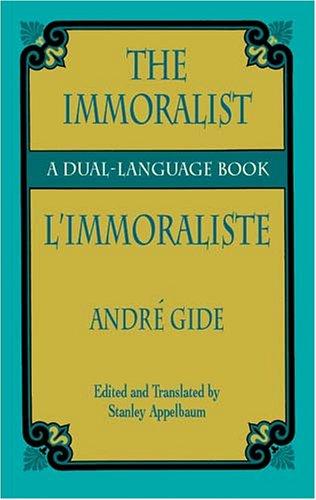
The Immoralist
André Gide · 1869–1951 · France
Originally L'Immoraliste (French)
Why it matters
A scholar recovers from illness into a hunger for sensation that consumes his wife and his conscience. Gide's slim, unsettling confession of amoral self-liberation taught the century to distrust the freedoms it most desired.
At a glance
A confessional frame narrative demanding attention to its moral ambiguities.
Deep dive
A dying man is nursed back to a hunger for pure sensation, and Gide watches his wife pay for that recovery without ever telling the reader whether it was worth it.
Written for readers who have finished the book. No plot recap, and nothing here is safe to read first.
Themes & symbolism
Michel's convalescence from tuberculosis in North Africa, and the voracious appetite for physical vitality that follows it, is staged by Gide as a genuine, almost religious conversion — Michel discovers his own body, and the sun, and the vigor of the local Arab boys he watches and befriends, as if for the first time, having spent his prior life entirely inside inherited scholarship and duty — but the novel refuses to let that awakening read as simple liberation: every increment of Michel's new hunger for sensation is purchased, directly and specifically, at his devoted wife Marceline's expense, her own health and needs receding exactly as his appetite for life expands.
Gide structures Michel's self-described 'immoralism' as a deliberately Nietzschean project — a will to live entirely for his own vitality, unconstrained by inherited morality, duty, or guilt — and refuses either to endorse or straightforwardly condemn it; the novel's famous 1902 preface insists Gide has 'not sought to prove anything' and that raising a problem honestly is not the same as solving it, a stance that scandalized contemporary readers expecting a moral verdict and that still leaves modern readers arguing about whether Michel's self-liberation is tragic, monstrous, admirable, or all three depending on which page you're on.
Michel's fascination with the young Arab boys of the Kabylie region — watching them, favoring one named Moktir even after catching him stealing from Marceline's sewing box, drawing increasingly coded homoerotic energy from their physical freedom — reads, with the biographical knowledge of Gide's own homosexuality (still closeted, still criminalized, at the time of writing), as a displaced confession threaded through a text that can't yet speak its actual subject directly; the novel's vitalism is also, underneath, an early and guarded attempt to articulate a desire Gide himself couldn't put into more direct language in 1902.
Gide's Refusal to Judge
Gide wrote the preface specifically to preempt readers who would want the book to condemn Michel outright, arguing that a novelist's job is to present a problem with total honesty rather than deliver a moral verdict disguised as fiction — a position that put him at odds with a reading public still largely expecting nineteenth-century fiction's clear separation of virtue rewarded and vice punished. The novel's genuinely unresolved ambiguity about whether Michel's self-liberation constitutes growth or monstrous selfishness has made it a recurring touchstone for later existentialist writers (Camus and Sartre both engaged with Gide directly) working through the same problem of freedom pursued without any external moral anchor to answer to.
The last seal: what actually happens, and why it lands the way it does.
The ending, explained
Having dragged the increasingly ill Marceline back to North Africa in pursuit of the vitality that first saved his own life, Michel watches her decline mirror his earlier illness in reverse, and she dies of tuberculosis in a squalid hotel room in Kabylie while Michel, unable to face returning home, keeps drifting deeper into the region rather than confronting what his pursuit of freedom has cost. The novel's frame narrative catches up with its opening: Michel, addressing friends who've come to hear his story, confesses everything with neither remorse nor pride, admitting he no longer knows what to do with the freedom he's won now that its price has been paid, and that he's kept a young local companion, Ali, near him more from habit and unresolved need than any clear purpose. Gide ends the confession without commentary, leaving Michel's friends, and the reader, to supply whatever judgment the author himself refused — the immoralist gets exactly the freedom he wanted and discovers, too late for it to help Marceline, that he has no idea what it was actually for.
Where to go next
 André Gide · 1909Strait Is the GateLvl 5Slow burn
 Joris-Karl Huysmans · 1884Against Nature (À rebours)Lvl 7Slow burn
 Oscar Wilde · 1890The Picture of Dorian GrayLvl 4Medium pace
 Fyodor Dostoevsky · 1866Crime and PunishmentLvl 6Fast paced
 Marcel Proust · 1913Swann's WayLvl 8Slow burn
 Jean-Paul Sartre · 1938NauseaLvl 6Slow burn