
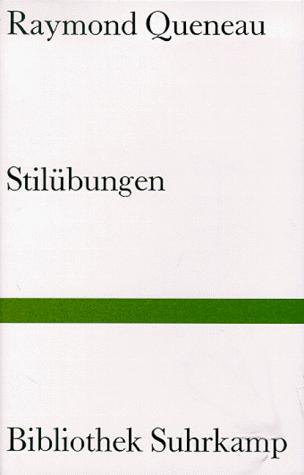
Exercises in Style
Raymond Queneau · 1903–1976 · France
Originally Exercices de style (French) · translated by Barbara Wright
Why it matters
The same trivial bus encounter is retold ninety-nine times in ninety-nine different styles, from sonnet to telegram to legalese. A formal experiment that became Oulipo's founding demonstration of constraint as creative engine.
At a glance
Each variation is short, but tracking ninety-nine stylistic constraints takes attention.
Deep dive
The same forgettable bus ride told ninety-nine ways — a look at why Queneau built the book like a fugue, and why its jokes are also its argument.
Written for readers who have finished the book. No plot recap, and nothing here is safe to read first.
Themes & symbolism
There is effectively nothing to say about what happens in Exercises in Style, and that's the entire design: a man on a crowded bus squabbles with another passenger over jostling, then turns up later near the Gare Saint-Lazare being told by a friend to add a button to his coat. Queneau repeats this nothing ninety-nine times, and the repetition trains the reader out of asking what happens and into asking how it's being told — sonnet, telegram, legal deposition, a version fixated on smell, a version that tortures a single vowel, a mathematical description reducing the scene to geometry, versions that are aggressively coarse or absurdly formal. Because the content never changes, style stops being a neutral delivery mechanism for meaning and becomes visibly, undeniably where the meaning and the pleasure actually live — the book's clearest possible proof, without a page of theory, that form isn't a container for a story but the thing doing all the work.
The book also quietly argues against the idea that some styles are more truthful or natural than others. A plain, unadorned retelling sits in the same list as the telegram and the sonnet, just one register among ninety-nine, robbed of any claim to being the neutral or default version of events. That leveling is part of the joke and part of the point: nothing here is presented as the real story with the others as distortions of it, because Queneau never gives the reader a baseline version to measure the rest against.
Oulipo's founding demonstration
Queneau reportedly conceived the project after hearing Bach's Art of Fugue and wanting an equivalent in prose: a single minimal theme submitted to endless formal variation. He wrote it before co-founding Oulipo with François Le Lionnais, but it already contains that group's whole thesis in miniature — that an arbitrary constraint doesn't limit a writer's invention, it manufactures invention that free, unconstrained writing would never have stumbled onto. Later Oulipians (Perec chief among them) would treat Exercises in Style as close to scripture: the proof-of-concept that made the group's stranger, more mathematically elaborate later experiments feel like a serious literary program rather than a stunt.
Funny and serious at once
Plenty of the individual exercises are simply, sharply funny on their own terms — send-ups of bureaucratic jargon, academic throat-clearing, or overwrought lyricism that land as jokes independent of the book's larger project. Queneau never treats the comedy and the argument as being in tension; the comic virtuosity is the argument, demonstrated rather than asserted. A reader who finishes the book laughing at the legalese version and the one told entirely as a series of questions has, without necessarily noticing, absorbed the same point a critic would take a chapter to argue: that style isn't decoration applied after the fact to a story, but the only place a story actually happens.
Where to go next
 Raymond Queneau · 1959Zazie in the MetroLvl 5Fast paced
 Georges Perec · 1978Life A User's ManualLvl 8Slow burn
 Italo Calvino · 1972Invisible CitiesLvl 5Slow burn
 André Gide · 1902The ImmoralistLvl 5Medium pace
 Marcel Proust · 1913Swann's WayLvl 8Slow burn
 Laurence Sterne · 1759The Life and Opinions of Tristram Shandy, GentlemanLvl 9Slow burn