
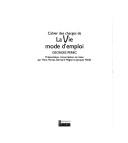
Life A User's Manual
Georges Perec · 1936–1982 · France
Originally La Vie mode d'emploi (French) · translated by David Bellos
Why it matters
Every apartment of a single Paris building is reconstructed in one frozen moment, following a chess-knight's path from room to room. An encyclopedic puzzle-novel of astonishing structural ambition, built around a jigsaw-maker's own devastating story.
At a glance
Encyclopedic cross-referencing and a rigorous knight's-tour structure to follow.
Deep dive
A guided tour of the novel's real engine room: the knight's-tour constraint governing which room you visit next, and the quietly devastating detail that decides how Bartlebooth's decades-long project actually ends.
Written for readers who have finished the book. No plot recap, and nothing here is safe to read first.
Themes & symbolism
Every object catalogued in the building at 11 Rue Simon-Crubellier — every unremarkable jar, painting, and heirloom itemized with the same exhaustive attention as the character histories attached to them — is Perec building a monument out of the sheer refusal to let anything go unnoticed. The novel's encyclopedic mode isn't ornamental thoroughness; it's an argument that this is what a life amounts to when nothing is allowed to be beneath notice — a hedge against the same erasure that mortality and forgetting perform on everyone in the building, rich or poor, remembered or not. Perec, an Oulipian working under a formal constraint (the chapters proceed room to room by the mathematical path of a chess knight across the building's floor plan) turns that arbitrary rule into the book's real subject: meaning doesn't precede the constraint here, it's produced by it, the same way Bartlebooth's own absurd rule-bound project generates a life's worth of feeling from a task with no purpose beyond its own execution.
Bartlebooth's scheme — ten years learning watercolor, five hundred harbor paintings made and shipped home to be cut into jigsaw puzzles by Gaspard Winckler, decades spent solving them, each solved puzzle re-glued, returned to the site it depicts, and dissolved back into blank paper — is explicitly engineered to leave no trace of itself. It's a monument to purposeful self-erasure, and the novel's tenderness toward it, despite (or because of) its total futility, is the clearest statement of the book's stance on obsession: elaborate, meaningless projects aren't a symptom to be diagnosed but one of the few available responses to time running out on everyone regardless.
Winckler's revenge
Gaspard Winckler, the jigsaw-maker Bartlebooth commissions, spends the decades of the project quietly resenting his patron's plan, and shapes some of the later puzzles with deliberate, cruel difficulty — pieces cut to frustrate rather than merely challenge. The novel lets this grudge simmer for hundreds of pages as background texture before it becomes load-bearing, a reminder that the building's grandest, most abstract scheme is still, underneath, a relationship between two men, one of whom never forgave being made an instrument of someone else's vanity. By the time the final, most punishing puzzles reach Bartlebooth, Winckler's grudge is effectively working on him from a distance, embedded in the pieces themselves rather than delivered in person.
The last seal: what actually happens, and why it lands the way it does.
The ending, explained
The novel's frozen central moment — 8pm, June 23, 1975 — turns out to be the moment Bartlebooth dies at his worktable, his failing eyesight and Winckler's late, deliberately punishing puzzle cuts having finally caught up with him before he could finish his final piece. The detail the book lands on is almost unbearably exact: the piece still in his hand is shaped like the letter W, while the gap waiting for it in the puzzle is shaped like an X. He dies holding the wrong piece for the hole in front of him — not from lack of effort or years, but from one last, absurd mismatch, so the entire decades-long machine built to erase itself without residue instead just stops, unfinished, a monument neither completed nor undone.
Where to go next
 Georges Perec · 1975W, or the Memory of ChildhoodLvl 6Slow burn
 Raymond Queneau · 1959Zazie in the MetroLvl 5Fast paced
 Italo Calvino · 1972Invisible CitiesLvl 5Slow burn
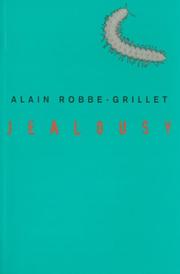 Alain Robbe-Grillet · 1957JealousyLvl 8Slow burn
 Annie Ernaux · 2008The YearsLvl 6Slow burn
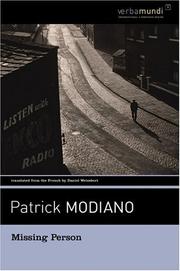 Patrick Modiano · 1978Missing PersonLvl 5Medium pace