
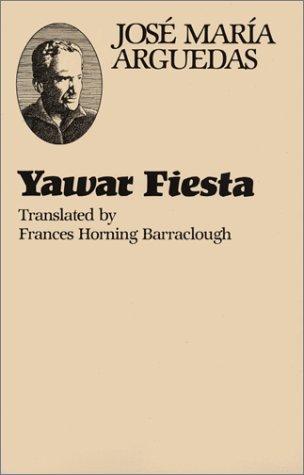
Yawar Fiesta
José María Arguedas · 1911–1969 · Peru
Originally Yawar Fiesta (Spanish)
Why it matters
An Andean town's mestizo authorities try to replace its violent Indigenous bullfighting ritual with a tamer, imported version, and the community's resistance becomes a referendum on who owns Peru. Arguedas's first novel, laying out the ethnographic double vision Deep Rivers would later deepen.
At a glance
Quechua-inflected Spanish and a wide village ensemble cast reward slow, attentive reading.
Deep dive
Why a Peruvian government ban on an indigenous bullfighting tradition becomes Arguedas's argument about who actually gets to define civilization in the Andes.
Written for readers who have finished the book. No plot recap, and nothing here is safe to read first.
Themes & symbolism
The turupukllay, the indigenous bullfighting tradition at the center of Yawar Fiesta, pits an untrained village bullfighter, often drunk on chicha and driven by raw nerve rather than technique, against a genuinely wild bull captured from the highlands, and Arguedas treats this ritual violence as something closer to communion than spectacle: the town of Puquio's indigenous comuneros don't watch the yawar punchay so much as inhabit it collectively, their own vitality bound up with the captured animal's. When the coastal authorities and local mestizo notables, the mistis, move to ban the tradition and replace it with a licensed Spanish-style corrida run by a professional matador, they're not just regulating a festival, they're trying to substitute an imported, rule-bound spectacle for a form of collective indigenous experience the mistis have never actually understood.
The capture of Misitu, a legendary, nearly unbeatable wild bull that a landowner's men fail to bring down and a party of Indian herders eventually succeed at taking, becomes the novel's clearest statement about where real authority in Puquio lies. Arguedas gives the successful capture to the comuneros specifically to undercut the mistis' presumption that indigenous tradition needs civilizing supervision from above. The people the state considers backward are the only ones in the novel capable of doing the thing the entire plot turns on.
The subprefecto sent from Lima to enforce the ban stands in for a whole administrative class that measures Andean life purely against a coastal, Europeanized standard of order, and Arguedas gives him just enough sympathy to make his failure land harder: he isn't a cartoon villain, only a functionary who has never once considered that the tradition he's suppressing might contain its own coherent logic rather than mere backwardness waiting to be corrected.
Arguedas Writing Between Two Languages
Arguedas grew up speaking Quechua before Spanish, raised largely among indigenous servants after his mother's early death, and Yawar Fiesta carries that bilingual formation directly into its prose, Spanish syntax bent to accommodate Quechua rhythms, vocabulary, and modes of address rather than smoothing them into standard literary Spanish. That linguistic hybridity was itself an argument in 1941, when indigenista fiction typically rendered indigenous characters in a Spanish that flattened or exoticized them. Arguedas's prose insists instead that Quechua thought has its own grammar worth preserving on the page, a technical choice inseparable from the novel's larger case that Puquio's traditions don't need translation into mestizo terms to be legitimate.
The last seal: what actually happens, and why it lands the way it does.
The ending, explained
Facing down the ban, Puquio's comuneros and their misti allies stage the yawar punchay anyway, on their own terms, with Misitu as the bull and a comunero rather than the imported professional matador facing him in the ring, and the festival goes forward exactly as tradition dictates despite every official effort to suppress or civilize it. Arguedas doesn't stage this as a clean political victory, the state's disapproval hasn't been overturned, only defied for one afternoon, but he ends the novel on the town's collective assertion of the tradition's continuation rather than on the authorities' response to it, making clear where the novel's own loyalties, and its sense of where Puquio's authentic vitality resides, ultimately sit.
Where to go next
 José María Arguedas · 1958Deep RiversLvl 6Medium pace
 Manuel Puig · 1976Kiss of the Spider WomanLvl 6Fast paced
 Mario Vargas Llosa · 1963The Time of the HeroLvl 6Medium pace
 José Rizal · 1887Noli Me TangereLvl 5Medium pace
 Camilo José Cela · 1942The Family of Pascual DuarteLvl 4Medium pace
 Mulk Raj Anand · 1935UntouchableLvl 3Fast paced