
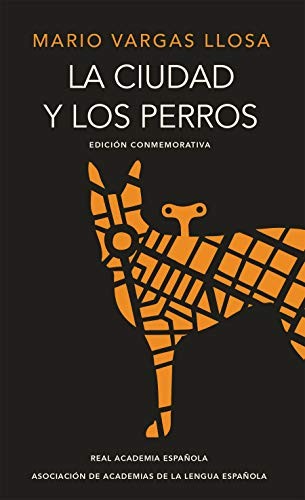
The Time of the Hero
Mario Vargas Llosa · 1936–2025 · Peru
Originally La ciudad y los perros (Spanish) · translated by Lysander Kemp
Why it matters
A theft, a code of silence, and a death inside a Lima military academy: Peru's institutions in miniature. The debut that launched the Boom's master builder; the academy burned a thousand copies on its parade ground.
At a glance
Interwoven timelines and shifting cadet narrators require close tracking of a cover-up.
Deep dive
How a stolen exam and a schoolyard code of silence at a military academy become Vargas Llosa's model for an entire country's institutions.
Written for readers who have finished the book. No plot recap, and nothing here is safe to read first.
Themes & symbolism
The Leoncio Prado Academy is Peru in miniature: a rigidly stratified hierarchy that claims to build character through discipline while actually running on humiliation, theft, and a code — the 'circle's' law of silence — that punishes honesty as the worst possible crime a cadet can commit. Vargas Llosa fractures the narrative across multiple cadets' perspectives and timelines specifically so that no single account of what happens can be trusted whole, which mirrors the institution itself: everyone inside it knows a different, partial, self-serving version of events, and the academy's whole function is to make sure those versions never reconcile into an inconvenient truth.
The nicknames — the Slave, the Jaguar, the Poet, Boa — strip the cadets of individual identity before the plot even starts, replacing personhood with function and rank the way the military does by design. The Slave's crime is believing the school's official rhetoric of honor is real and reporting the Jaguar's theft accordingly; his death is the novel's proof that the academy's actual values run the opposite direction from its stated ones, rewarding whoever protects the group's omertà and erasing whoever appeals to the rules as written.
A Debut That Got Burned on Its Own Parade Ground
Vargas Llosa wrote much of the novel from his own two years as a cadet at the real Leoncio Prado Military Academy in Lima, and the school's response on publication in 1963 was to organize a public ceremony burning a thousand copies of the book on the academy's parade ground, alongside furious denunciations from serving officers who called it slanderous fiction cooked up by a traitor. The overreaction more or less proved the novel's point: an institution that responds to a portrait of its own cover-up culture by staging a public bonfire is not an institution confident that the portrait is wrong. The book made Vargas Llosa's international reputation overnight and set the template — realist surface, fractured chronology, institutional rot as subject — that would recur across his best work for the next two decades.
The Boom's Founding Generation
The Time of the Hero arrived just as García Márquez, Fuentes, Cortázar, and Vargas Llosa himself were about to be marketed collectively, mostly by European and North American publishers, as the Latin American 'Boom' — a generation whose formal daring got attached, whether they liked it or not, to a wave of leftist political energy following the Cuban Revolution. Vargas Llosa's own politics would later swing hard rightward, famously souring his friendship with García Márquez into a decades-long, once even physically violent, rupture, but this first novel still shares the Boom's foundational instinct: use the most sophisticated available technique — multiple unreliable narrators, chronological collage — to indict a Latin American institution from the inside rather than simply denouncing it from without.
The last seal: what actually happens, and why it lands the way it does.
The ending, explained
Lieutenant Gamboa, the one adult in the novel who takes the academy's rules at face value, investigates the Slave's death during field exercises and becomes convinced it was no accident — that the Jaguar shot him in retaliation for breaking the code of silence. But when Gamboa pushes the case upward, his superiors, far more concerned with the school's public reputation than with a dead cadet from a family with no influence, quietly close the investigation as a training accident and transfer the inconveniently principled Gamboa to a remote post as punishment for asking questions. The Jaguar graduates untouched, confesses privately to Alberto, another cadet, that he did do it, and the novel's last, coldest irony lands when the Jaguar ends up together with Teresa, the girl the dead Slave had quietly loved from a distance. Nothing is avenged, nothing is exposed, and the institution absorbs its own crime so completely that by graduation day it's as if the Slave barely existed — which is exactly the mechanism Vargas Llosa is diagnosing: Peruvian authority survives not by punishing wrongdoing but by making sure wrongdoing never becomes anyone's problem to solve.
Where to go next
 Mario Vargas Llosa · 1966The Green HouseLvl 8Slow burn
 Mario Vargas Llosa · 1969Conversation in The CathedralLvl 9Slow burn
 Mario Vargas Llosa · 1977Aunt Julia and the ScriptwriterLvl 4Fast paced
 Mario Vargas Llosa · 1981The War of the End of the WorldLvl 7Medium pace
 Mario Vargas Llosa · 2000The Feast of the GoatLvl 6Fast paced
 Carlos Fuentes · 1962The Death of Artemio CruzLvl 8Slow burn