
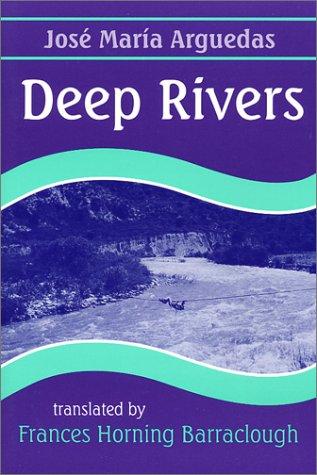
Deep Rivers
José María Arguedas · 1911–1969 · Peru
Originally Los ríos profundos (Spanish)
Why it matters
A boy shuttled between his itinerant father and a religious boarding school in the Andes is torn between Quechua Indigenous cosmology and the racial hierarchy Spanish-speaking Peru enforces around him. Andean life narrated from inside, not as folklore but as lived world.
At a glance
Quechua vocabulary and rhythms woven directly into the Spanish prose reward unhurried, attentive reading.
Deep dive
How a boy suspended between two entire worldviews narrates both from the inside, and why Arguedas refuses to let either one win.
Written for readers who have finished the book. No plot recap, and nothing here is safe to read first.
Themes & symbolism
The zumbayllu, the spinning top a schoolmate gives Ernesto, is the novel's central image of reconciliation: a manufactured toy whose hum, when it's right, seems to open onto the same order Ernesto feels in rivers, insects, and Quechua song, briefly letting a Hispanic object and an Indigenous cosmology share one continuous world even as the society around him insists on absolute separation and hierarchy. Rivers do the same work at larger scale — indifferent to property lines and racial caste, running straight through both the hacienda world and the Indigenous communities the hacienda exploits, a continuity the town's social order can't touch.
The Spanish prose itself carries this doubleness formally: threaded with untranslated Quechua words and rhythms, it holds a cosmology that resists full translation into the colonizer's language even while being written in it, enacting Ernesto's own irreducible split. The boarding school's racial hierarchy — white and mestizo students dominating Indigenous ones — is rendered without sentimentality, including Ernesto's own painful complicity and helplessness inside a system he despises but can't simply exit, since his education and his Hispanic surname tie him to the world his heart has already left.
Arguedas's Own Divided Childhood
Arguedas lived the novel before he wrote it. After his mother's early death, a hostile stepmother effectively exiled him to the household's Indigenous servants, where Quechua became something close to his first emotional language and Andean communal life something he absorbed from inside rather than observed — a rare vantage among Peru's mostly white, Lima-centered literary establishment. He went on to work as a trained ethnographer alongside his fiction, and insisted Deep Rivers be read not as indigenista advocacy written about Indigenous people from outside, but as an attempt to render lived interior experience — his own included. In 1969, worn down by despair over Peru's condition and his sense of belonging fully to neither of his two worlds, Arguedas shot himself in his university office, a fact that retroactively darkens the novel's refusal to resolve its central tension: irresolution wasn't a technique he could ultimately sustain in his own life.
The last seal: what actually happens, and why it lands the way it does.
The ending, explained
The novel's climax is collective rather than personal: chicheras — women who brew and sell the corn beer chicha — storm the town to protest the hoarding of salt by wealthy landowners, briefly inverting the racial and gender hierarchy the school otherwise enforces and showing Ernesto a vision of open Indigenous and mestizo defiance that Catholic schooling never offers him. A typhus epidemic follows, devastating the town's poor while the privileged wall themselves off, and the local priest's cynicism in the face of mass suffering exposes the moral bankruptcy of the institution meant to be educating Ernesto. As the epidemic recedes and the school empties, Ernesto leaves to rejoin his father's itinerant life, still suspended between the order he feels in rivers and the zumbayllu and the racist hierarchy structuring his days above ground. Arguedas ends it there deliberately: resolving the tension would falsify the actual, still-unresolved condition of Andean Peru the novel is reporting from inside.
Where to go next
 José María Arguedas · 1941Yawar FiestaLvl 6Medium pace
 Manuel Puig · 1976Kiss of the Spider WomanLvl 6Fast paced
 Mario Vargas Llosa · 1963The Time of the HeroLvl 6Medium pace
 José Rizal · 1887Noli Me TangereLvl 5Medium pace
 Camilo José Cela · 1942The Family of Pascual DuarteLvl 4Medium pace
 Mulk Raj Anand · 1935UntouchableLvl 3Fast paced