
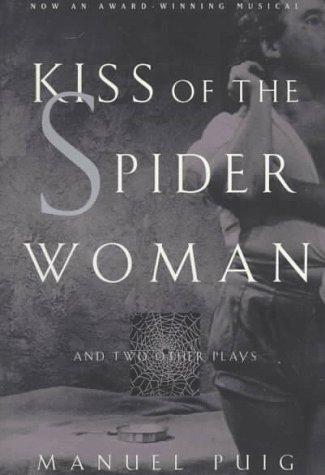
Kiss of the Spider Woman
Manuel Puig · 1932–1990 · Argentina
Originally El beso de la mujer araña (Spanish) · translated by Thomas Colchie
Why it matters
A gay window-dresser and a Marxist revolutionary share a cell, where retold movies become an act of love. Puig builds the whole novel from dialogue and footnotes: the Boom's myth traded for tenderness and kitsch.
At a glance
Told almost entirely in unattributed dialogue and academic footnotes, with no conventional narration.
Deep dive
How two prisoners build an entire love story out of B-movie plots, and what happens when the novel finally lets its own footnotes take over.
Written for readers who have finished the book. No plot recap, and nothing here is safe to read first.
Themes & symbolism
Puig strips out the narrator almost entirely — the novel is nearly all transcribed dialogue between Molina and Valentin, with occasional prison reports and a string of scholarly footnotes on the history and theory of homosexuality standing in for authorial comment. The choice isn't a stylistic flourish so much as the book's whole argument made structural: identity here is produced in speech and performance, not delivered by an omniscient narrator asserting who these men really are. Molina retells B-movies from memory — a woman who turns into a panther when aroused, a doomed wartime romance with Nazi propaganda undertones — as entertainment for Valentin and, initially, as material extracted for the warden in exchange for privileges. What begins as manipulation becomes the only real intimacy either man has access to inside the cell.
The footnotes, tracking real and invented psychoanalytic theories of homosexuality from Freud to later revisionists, sit in ironic counterpoint to what's happening a few inches above them on the page: theory groping toward a clinical account of desire while Molina simply lives his, generously and without needing the vocabulary to justify it. Valentin arrives a doctrinaire Marxist revolutionary contemptuous of Molina's "bourgeois" movie-star fantasies, and the novel's real romance is ideological as much as erotic — his gradual admission that Molina's soft, sentimental, popular-culture-soaked way of surviving the world is not a lesser mode of consciousness than his own theorized one. By the time Molina volunteers to smuggle a message to Valentin's comrades on his release, the two have effectively traded positions: the revolutionary has learned tenderness, the queen has learned commitment.
Kitsch as a Rival to the Boom
Puig came up alongside García Márquez and Vargas Llosa but rejected the Boom's high-literary, mythic register entirely, building his fiction instead from radio serials, Hollywood melodrama, and the popular songs and films of his own provincial Argentine childhood. Kiss of the Spider Woman makes that allegiance explicit: Molina's retold movies aren't ironic decoration on a serious political novel, they're offered as equally serious, a claim that mass culture carries as much emotional truth as revolutionary theory and can do work theory can't — reach someone theory has no language for. It's a quietly radical rebalancing of what counts as literature, coming from inside the same literary movement it's arguing against.
The last seal: what actually happens, and why it lands the way it does.
The ending, explained
Released on parole, Molina agrees to carry a message to Valentin's revolutionary contacts — whether from genuine loyalty to Valentin or coerced complicity is left permanently unresolved — and is shot dead in the street shortly after, an assassination the novel renders through a detached, almost clinical surveillance report rather than a dramatized scene, denying the reader the emotional close-up his death would get in one of his own beloved films. The final chapter abandons realism altogether: back in his cell and being tortured, Valentin slides into a morphine-hazed dream that fuses with the plots he and Molina traded all novel, conjuring an idealized woman — half spider-woman, half revolutionary comrade — who offers comfort his waking life can't. The novel ends inside that fantasy rather than outside it, formal proof that the movies were never an escape from the men's reality, but the only medium tender enough to hold it.
Where to go next
 Manuel Puig · 1968Betrayed by Rita HayworthLvl 7Medium pace
 Fernando del Paso · 1977Palinuro of MexicoLvl 9Slow burn
 José Donoso · 1970The Obscene Bird of NightLvl 9Slow burn
 Sergio Pitol · 1996The Art of FlightLvl 7Slow burn
 Elena Poniatowska · 1971Massacre in MexicoLvl 5Medium pace
 Reinaldo Arenas · 1969HallucinationsLvl 7Fast paced