
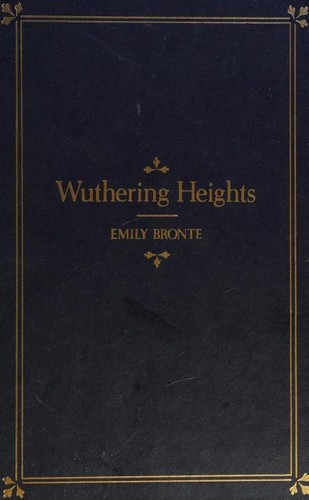
Wuthering Heights
Emily Brontë · 1818–1848 · England
Why it matters
A love story only in the way a storm is weather: nested narrators circle Heathcliff and Catherine's amoral, annihilating bond. Victorian critics recoiled; the novel outlived every stricture: nothing else in the canon sounds like it.
At a glance
Nested unreliable narrators and a tangled multi-generational timeline.
Deep dive
How the novel's nested narrators hold Heathcliff and Catherine at arm's length, and why the moors do the moral work the story itself refuses.
Written for readers who have finished the book. No plot recap, and nothing here is safe to read first.
Themes & symbolism
Nelly Dean's retrospective account, filtered again through the outsider Lockwood, keeps Heathcliff and Catherine at two removes — we get them almost entirely secondhand, through a diary fragment, a reported outburst, a housekeeper's judgment. That distance matters because the bond at the novel's center isn't a marriage-plot romance to be rooted for; "I am Heathcliff" is Catherine's declaration of identity, not affection, a merger the book refuses to sentimentalize or moralize away even as it goes on to destroy everyone within reach of it.
The moors versus the two houses map the whole scheme: Wuthering Heights is wild and exposed, Thrushcross Grange is enclosed and civilized, and Catherine and Heathcliff belong, by temperament, to the weather and the heath — appetite without socialization — while Edgar Linton's genteel domesticity is the civilization Catherine trades her nature for and never forgives herself over. Heathcliff's revenge, once he returns with money, is inflicted largely on people who never wronged him — Isabella, Hareton, his own dying son — which is the point: it isn't justice, it's contagion, passed down a generation until something finally breaks the transmission.
Hareton and Cathy: The Cycle Breaks
The younger Catherine and Hareton Earnshaw are the novel's quiet counter-argument to everything the first generation did to each other. Hareton, degraded and left illiterate by Heathcliff's deliberate cruelty, is taught to read by young Cathy in the novel's final chapters, and their slow, unglamorous courtship — built on patience and correction rather than annihilating passion — answers the Catherine-and-Heathcliff bond without repudiating it. The book doesn't argue that its first, elemental love was wrong; it argues that a house can only survive one generation of it. Published in 1847 under the androgynous pseudonym Ellis Bell, the novel baffled and repelled most of its first reviewers, who found its violence and moral neutrality close to unreadable; Emily Brontë died the following year, at thirty, of tuberculosis, without living to see it recognized as anything other than a strange, minor curiosity beside her sister's more palatable Jane Eyre — its reputation as the greater, stranger novel is almost entirely a twentieth-century verdict.
The last seal: what actually happens, and why it lands the way it does.
The ending, explained
Having achieved total material revenge — both houses, a broken Hareton, a forced marriage between his dying son and young Cathy — Heathcliff finds the victory hollow. He starts sensing Catherine everywhere, stops eating, and dies within days, effectively willing himself to rejoin her; he's buried beside her with the adjoining coffin sides removed so the two can mingle underground. Locals afterward report seeing Heathcliff and Catherine's ghosts walking the moor together, and the novel treats this matter-of-factly, neither confirming nor debunking it. Freed by his death, Hareton and young Cathy begin restoring the Heights — and each other — into the ordinary, healed love the first generation was never allowed.
Where to go next
 Thomas Hardy · 1891Tess of the d'UrbervillesLvl 4Medium pace
 Charlotte Brontë · 1847Jane EyreLvl 4Medium pace
 Ann Radcliffe · 1794The Mysteries of UdolphoLvl 5Slow burn
 Mary Shelley · 1818FrankensteinLvl 4Medium pace
 Giovanni Verga · 1881The House by the Medlar TreeLvl 6Slow burn
 Gustave Flaubert · 1857Madame BovaryLvl 5Slow burn