
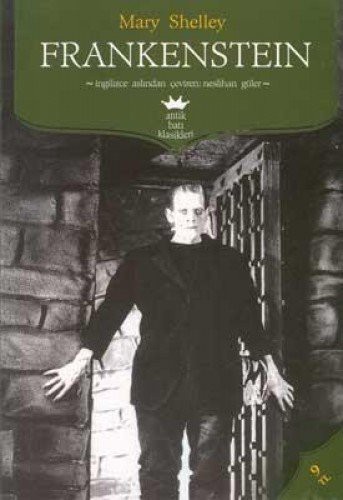
Frankenstein
Mary Shelley · 1797–1851 · England
Why it matters
Written at eighteen, it founded science fiction and gave modernity its master-myth: the creation that turns on its creator. The creature (eloquent, abandoned, murderous) remains literature's great question about what makers owe the made.
At a glance
Nested narrators and formal epistolary framing around otherwise clear Romantic prose.
Deep dive
Why the real transgression in this novel isn't creation itself but the five minutes of horror and flight that follow it.
Written for readers who have finished the book. No plot recap, and nothing here is safe to read first.
Themes & symbolism
The novel nests three unreliable narrators — Walton's letters enclosing Victor's confession enclosing the Creature's own testimony — so that no single account is authoritative, and each teller is performing for a listener whose approval he craves. That structure carries the book's real argument: Victor's crime isn't animating dead matter, it's what he does in the moments after, recoiling in disgust at his own handiwork and abandoning it to fend for itself. Prometheus stole fire and was punished for the theft; Victor is punished for the ordinary, unmythic sin of an absent parent.
The Creature's eloquence is the novel's most radical stroke. He teaches himself language by eavesdropping on a cottage family and reading Paradise Lost, Plutarch, and Werther, then uses that education to build a case, point by point, that his violence was manufactured by rejection rather than innate to his making. He identifies with both Adam (created, then abandoned) and Satan (cast out, and vengeful for it), and the novel refuses to let a reader settle comfortably on "monster." Victor and the Creature work as doubles — each destroys what the other loves, each ends up alone on the ice — and the murders that ladder toward Elizabeth's wedding night are the Creature forcing Victor to feel the isolation he first inflicted.
A Teenager's Ghost Story
Mary Shelley was eighteen, at Lake Geneva with Percy Shelley and Byron in the miserable, volcano-darkened summer of 1816, when Byron's challenge to write a ghost story produced the novel's germ. She had already lost a premature daughter and would lose more children in the years around its writing; her own mother, Mary Wollstonecraft, died of complications from giving birth to her. A book obsessed with botched creation, dead infants, and the guilt of the maker who can't protect what he's made reads very differently once that biography is in view — it isn't only a treatise on science's limits, it's the work of a young woman thinking hard about birth, death, and culpability from the inside.
The last seal: what actually happens, and why it lands the way it does.
The ending, explained
Victor pursues the Creature into the Arctic, collapses, and is taken aboard Walton's ship, where he finishes his confession and dies — still framing himself as avenger as much as culprit, urging Walton to continue the hunt he himself couldn't finish. The Creature then appears over Victor's body and mourns him with what reads as genuine grief and guilt, the first moment his account and Victor's converge. He tells Walton he will build his own funeral pyre and vanishes across the ice; his death is never confirmed. That ambiguity is deliberate — the novel won't hand readers a tidy verdict on whether the Creature is destroyed by his making or by the world's rejection of it. Walton, mid-way through his own glory-seeking overreach, is the one character who learns anything: he turns his ship back.
Where to go next
 Mary Shelley · 1826The Last ManLvl 7Slow burn
 Johann Wolfgang von Goethe · 1774The Sorrows of Young WertherLvl 3Medium pace
 Heinrich von Kleist · 1810Michael KohlhaasLvl 6Fast paced
 Walter Scott · 1814WaverleyLvl 6Medium pace
 Emily Brontë · 1847Wuthering HeightsLvl 6Medium pace
 Honoré de Balzac · 1835Père GoriotLvl 4Medium pace