
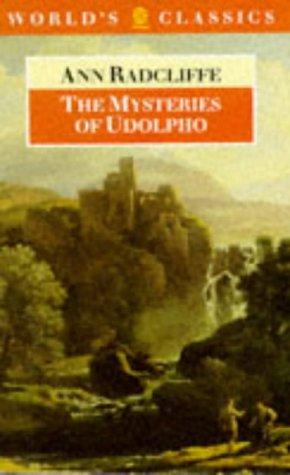
The Mysteries of Udolpho
Ann Radcliffe · 1764–1823 · England
Why it matters
An orphaned heroine is imprisoned in a crumbling Apennine castle of veiled portraits and half-heard screams: terrors that turn out, by the final chapters, to have rational explanations. The Gothic's founding bestseller, and Austen's direct target in Northanger Abbey.
At a glance
Ornate, adjective-heavy description stretched across a very long gothic plot.
Deep dive
Every ghost in this castle turns out to have a rational explanation, and Radcliffe wants you to notice how little that actually helps.
Written for readers who have finished the book. No plot recap, and nothing here is safe to read first.
Themes & symbolism
Radcliffe's signature device — the 'explained supernatural,' in which every apparently ghostly event (a moving figure behind a black veil, mysterious music, a corpse that seems to reappear) is eventually resolved into a mundane, if often still sinister, human cause — is often treated as a concession to Enlightenment rationalism, but the novel's real interest is in how thoroughly the dread survives the explanation. Emily St. Aubert's terror at Udolpho is produced less by any actual ghost than by isolation, uncertainty, and a predatory guardian's total control over her circumstances, and Radcliffe's insistence on rational solutions doesn't cancel the horror so much as relocate it from the supernatural to the social: the true danger was always Montoni, not a spectre.
Emily's aesthetic education — she's established early as a devotee of the sublime, moved to tears by mountain vistas and stormy seas in ways her more sensible aunt finds tiresome — is the novel's own theory of itself: Radcliffe stages Udolpho's crags and shadows with the same rapturous landscape language Emily applies to the Pyrenees, training the reader to feel the sublime's mix of terror and pleasure as an aesthetic experience even while the plot insists that indulging feeling without judgment (as Emily's father warns her against in the opening pages) is exactly the vulnerability Montoni exploits.
Montoni's marriage to Emily's aunt, contracted explicitly for her property, and his subsequent attempt to force Emily to sign away her own inheritance, keeps the novel's Gothic terror rooted the entire time in a distinctly unglamorous motive — money, and specifically the legal vulnerability of women's property under a guardian's control — so that Udolpho's famous atmosphere of veils and midnight passages sits over a plot that is, underneath, a study of inheritance law and coercion as thoroughly as it is a haunted-castle story.
The Book Austen Wrote Northanger Abbey Against
Udolpho was the best-selling and most influential Gothic novel of its decade, and Jane Austen used it directly as the target of Northanger Abbey two decades later, having her impressionable heroine Catherine Morland import Radcliffe's plot wholesale onto an ordinary English country house and suspect her host of murder on no evidence but genre convention. Austen's satire works precisely because Udolpho's conventions — the veiled portrait, the tyrannical guardian, the imprisoned heroine, the eventual rational unmasking of every apparent horror — were, by the 1790s, familiar enough to a novel-reading public that Austen could assume her readers would recognize every beat being gently mocked.
The last seal: what actually happens, and why it lands the way it does.
The ending, explained
Escaping Udolpho and Montoni's Italy, Emily returns to France, where the novel's two lingering mysteries — the terror behind the black veil, and a mysterious woman connected to her family's chateau — resolve as almost anticlimactically mundane: the veil concealed a wax effigy used for penance, and the woman is Signora Laurentini, Montoni's presumed-dead former associate, who confesses on her deathbed to a decades-old crime. Reunited with Valancourt, whose Paris dissipation turns out more foolish than corrupt, Emily marries him, both families' fortunes restored. Radcliffe's insistence on tidying up every supernatural hint with a rational, faintly deflating explanation is the novel's thesis delivered one last time: the sublime terror the book spent six hundred pages cultivating was always, underneath, explicable — which doesn't make it any less effective while you're inside it.
Where to go next
 Ann Radcliffe · 1797The ItalianLvl 5Fast paced
 Walter Scott · 1814WaverleyLvl 6Medium pace
 Johann Wolfgang von Goethe · 1774The Sorrows of Young WertherLvl 3Medium pace
 Emily Brontë · 1847Wuthering HeightsLvl 6Medium pace
 E. T. A. Hoffmann · 1816The SandmanLvl 6Medium pace
 Alessandro Manzoni · 1827The BetrothedLvl 5Medium pace