
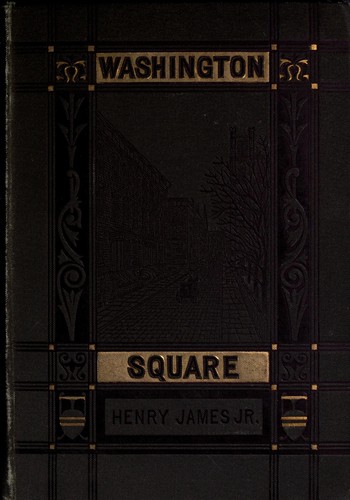
Washington Square
Henry James · 1843–1916 · USA / England
Why it matters
A plain, dutiful heiress endures her father's cold contempt and a suitor who may only want her money. James's leanest, most Austen-like novel is also his cruelest: a study in quiet, permanent paternal damage.
At a glance
Clear, restrained early-James prose makes this his most accessible novel.
Deep dive
What Catherine Sloper actually wins by turning down both the father who never respected her and the suitor who never loved her enough.
Written for readers who have finished the book. No plot recap, and nothing here is safe to read first.
Themes & symbolism
Dr. Austin Sloper's love for his daughter is conditional on a comparison she can never win: his wife, dead in childbirth delivering Catherine, was brilliant and beautiful, and Sloper spends the whole novel measuring his plain, unremarkable, entirely sincere daughter against a ghost. When the charming, penniless Morris Townsend begins courting Catherine, Sloper's objection isn't really about protecting her from a fortune hunter, it's an extension of the same contempt: he assumes so little of Catherine's judgment that he can't imagine any man loving her for herself, and structures a punishing bet, disinherit her if she defies his wishes, to prove his own low opinion of her correct.
James builds the novel's real drama around what Catherine does with that contempt rather than around whether Morris is sincere, he isn't, and the novel never pretends otherwise. Her aunt Lavinia Penniman, a widow addicted to romantic intrigue for its own sake, keeps pushing Catherine toward Morris less out of concern for her niece's happiness than for the pleasure of stage-managing a secret courtship, one more voice treating Catherine as a supporting character in someone else's story. Catherine's slow recognition that everyone around her, father, aunt, suitor, is authoring a version of her life she never agreed to is the novel's actual plot.
James Against Balzac
James wrote Washington Square consciously in the shadow of Balzac's Eugénie Grandet, another novel about a plain heiress, a domineering father, and a suitor after her money, and later dismissed his own book as too indebted to the French model to fully claim. The difference James couldn't quite see in himself is the one that makes the book work: Eugénie ends the Balzac novel a wealthy recluse defined entirely by her loss, where Catherine ends James's novel having chosen her solitude, deliberately, twice, which is a much colder kind of ending to write convincingly.
A Square as a Whole World
James sets the novel in the actual Washington Square of his own childhood, the fashionable, tightly bounded New York neighborhood his family had left by the time he wrote the book, and keeps Catherine's entire adult life inside a few blocks of it, her father's house, the square's paths where Morris courts her, the drawing room where every important scene takes place. The geography's smallness isn't incidental, it's the visible shape of how few choices Catherine has actually been given, and how much attention it takes to notice that walking away from two men within the same few square blocks still counts as the largest action available to her.
The last seal: what actually happens, and why it lands the way it does.
The ending, explained
Catherine eventually recognizes Morris's courtship for what it is and breaks with him herself, years before her father dies; Sloper, still unconvinced of his daughter's judgment even on his deathbed, cuts most of her inheritance anyway, less to punish a match that never happened than to make a final point about how little he ever trusted her choices. Morris, older and unsuccessful, resurfaces after Sloper's death to try the courtship again, banking on Catherine's old feelings and her now-reduced but still comfortable fortune. James gives Catherine a response with no melodrama in it at all: she receives him politely, declines plainly, and picks her needlework back up as he leaves, the same domestic occupation she's kept up throughout the book, now revealed as the actual center of the life she's chosen for herself rather than the placeholder James's readers might have assumed it was.
Where to go next
 Henry James · 1881The Portrait of a LadyLvl 6Slow burn
 Henry James · 1886The BostoniansLvl 6Slow burn
 Henry James · 1898The Turn of the ScrewLvl 7Medium pace
 Henry James · 1902The Wings of the DoveLvl 8Slow burn
 Henry James · 1903The AmbassadorsLvl 9Slow burn
 Edith Wharton · 1905The House of MirthLvl 5Medium pace