
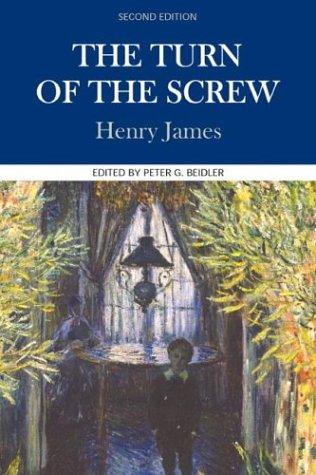
The Turn of the Screw
Henry James · 1843–1916 · USA / England
Why it matters
A governess, two children, and ghosts that may be hers alone: ambiguity engineered so perfectly that critics have fought for a century. The unreliable narrator's founding masterclass.
At a glance
Deliberately ambiguous narration and serpentine syntax resist easy interpretation.
Deep dive
Whether the governess protecting two children at Bly is defending them from actual ghosts or supplying the danger herself is the argument James built to never resolve.
Written for readers who have finished the book. No plot recap, and nothing here is safe to read first.
Themes & symbolism
James frames the entire tale as a manuscript, read aloud decades after the fact by a guest named Douglas at a Christmas gathering, itself introduced by an unnamed narrator transcribing what Douglas reads: two more layers of telling between the reader and whatever actually happened at Bly, and every one of them belongs to a source with a reason to be believed rather than a reason to be doubted. The governess's own account is the only version of events available, and James gives her prose exactly the fevered, self-justifying quality of someone building a case, not simply reporting one.
Peter Quint and Miss Jessel, the estate's dead valet and former governess, appear only to the governess and, she insists, to Flora and Miles, always at a distance: on a tower, across a lake, through a dining-room window. James's ghosts do almost nothing a ghost is supposed to do, they don't speak, don't touch, don't demonstrably act on the world at all, which is what makes Edmund Wilson's 1934 reading, that the governess hallucinates the pair out of repressed longing for the children's absent uncle who hired her on the explicit condition that she never contact him, so durable. The children's own behavior, precocious, evasive, occasionally cruel in ways that could be read as either possession or ordinary childhood secrecy, never breaks the tie between the two readings.
A Manuscript With No Living Author
By the time Douglas reads the governess's account aloud, she has been dead for years, and Douglas himself, the one person who could vouch for her character, offers only that he'd been in love with her as a young man, hardly a disinterested witness. James builds the frame so that every possible authority who might confirm the governess's sanity is unavailable, deceased, or compromised, leaving the reader with a document that asks to be trusted by a narrator who structurally cannot be cross-examined.
Quint at the Window
The governess's first sighting of Quint on the tower and her second, his face pressed to the dining-room window looking in at her rather than at the children, invert the usual haunting: the ghost seems to be watching the governess specifically, which she reads as proof he's after the children through her. James never lets the apparition's gaze settle on anything but her own perception of it, so the scene that ought to confirm the threat's reality only confirms how completely the governess has made herself its center.
The last seal: what actually happens, and why it lands the way it does.
The ending, explained
In the final confrontation, the governess isolates Miles after Flora has been sent away, and presses him, with mounting, almost violent intensity, to admit he sees Quint at the window behind them. Miles finally cries out the dead man's name, apparently confirming everything the governess believed, at the exact moment James lets the apparition, if it was ever there, vanish for good. Miles collapses in her arms, his heart, in James's own phrase, "dispossessed," stopped. James refuses to specify whether Miles has been frightened by a genuine ghost, crushed by the governess's suffocating insistence that he confess to something he may not have seen at all, or simply overwhelmed by a scene an already fragile boy should never have been subjected to. The title's turn of the screw describes exactly this: each new development tightens the reader's uncertainty rather than releasing it, right through the last sentence.
Where to go next
 Henry James · 1880Washington SquareLvl 4Medium pace
 Henry James · 1881The Portrait of a LadyLvl 6Slow burn
 Henry James · 1886The BostoniansLvl 6Slow burn
 Henry James · 1902The Wings of the DoveLvl 8Slow burn
 Henry James · 1903The AmbassadorsLvl 9Slow burn
 Edith Wharton · 1905The House of MirthLvl 5Medium pace