
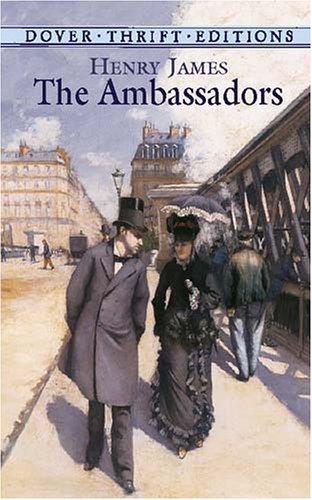
The Ambassadors
Henry James · 1843–1916 · USA / England
Why it matters
A middle-aged American is sent to Paris to bring a wayward young man home, and finds himself seduced instead by everything he'd never let himself want. James called it his most perfectly achieved novel: consciousness itself as plot.
At a glance
Told almost entirely through one character's shifting perception, in James's densest late prose.
Deep dive
A middle-aged Massachusetts man is sent to Paris to rescue a young man from a corrupting attachment, and finds the city rearranging everything he thought he knew about what a corrupting attachment even looks like.
Written for readers who have finished the book. No plot recap, and nothing here is safe to read first.
Themes & symbolism
Lambert Strether, engaged to the formidable, largely unseen Mrs. Newsome back in Woollett, Massachusetts, is dispatched to Paris to retrieve her son Chad from whatever's kept him abroad, and finds Chad transformed: polished, socially fluent, plainly improved by an attachment Strether assumes must be a Frenchwoman's corrupting influence. Instead he meets Madame de Vionnet, elegant, separated, and older than Chad, and finds himself persuaded that whatever she's given him looks less like vice than education, a civilizing influence Strether comes to envy rather than condemn.
James builds the novel almost entirely around the slow drift of Strether's own perception, his advice to a young acquaintance to live all you can becoming the book's most quoted line and its central irony, offered before Strether has fully registered how much of his own life he's failed to live. The real tension isn't whether he'll bring Chad home to Woollett but whether Strether can keep believing in the virtuous-attachment theory he's built once the evidence in front of him starts working against it.
Sarah Pocock's Arrival as an Ultimatum
Once Strether's letters home go quiet, Mrs. Newsome dispatches a second embassy, her daughter Sarah Pocock and Sarah's husband, whose rigid moral certainty about Chad's situation throws Strether's own compromised, more permissive vision into unflattering relief, and their arrival turns what had been an internal, contemplative novel into something closer to a diplomatic standoff between two entirely incompatible ways of judging the same set of facts.
Little Bilham's Half-Truth
Chad's young expatriate friend Little Bilham describes the arrangement with Madame de Vionnet to Strether as a virtuous attachment, a phrase Strether seizes on and repeats to himself for months as license to stop worrying and start admiring, and James lets the reader watch an ambassador build an entire moral position on a term one minor character offered almost carelessly, a case study in how badly Strether wants to be told what he's already decided to believe.
The last seal: what actually happens, and why it lands the way it does.
The ending, explained
On a countryside outing, Strether unexpectedly comes upon Chad and Madame de Vionnet together on a river, staged with a casualness that instantly betrays what months of careful drawing-room decorum had let him not quite know: the relationship is, and has been, a sexual affair rather than the elevating friendship he'd allowed himself to believe in. The discovery costs Strether the theory he'd built his late-life awakening on, but doesn't reverse it; he still urges Chad, now pressured by his family and the promise of the business waiting for him at home, to stay in Paris rather than abandon Madame de Vionnet for money and convenience. Strether himself, having wrecked his engagement to Mrs. Newsome and gained nothing tangible in exchange, chooses to return to America anyway, declining a comfortable offer to remain, insisting he wants nothing for himself out of the whole affair, a renunciation James frames not as defeat but as the one fully deliberate act of Strether's belated life.
Where to go next
 Henry James · 1880Washington SquareLvl 4Medium pace
 Henry James · 1881The Portrait of a LadyLvl 6Slow burn
 Henry James · 1886The BostoniansLvl 6Slow burn
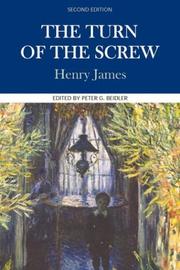 Henry James · 1898The Turn of the ScrewLvl 7Medium pace
 Henry James · 1902The Wings of the DoveLvl 8Slow burn
 Edith Wharton · 1905The House of MirthLvl 5Medium pace