
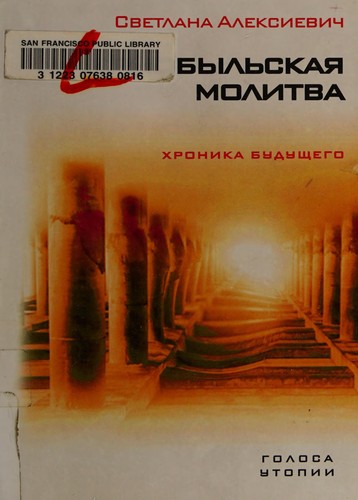
Voices from Chernobyl
Svetlana Alexievich · b. 1948 · Belarus
Originally Chernobylskaya Molitva (Russian) · translated by Keith Gessen
Why it matters
Firefighters' widows, evacuated villagers, and Chernobyl liquidators narrate the disaster and its aftermath in their own words, assembled into oral-history fiction. Alexievich's signature polyphonic method applied to catastrophe.
At a glance
Plainly transcribed oral testimony, structurally simple but emotionally demanding.
Deep dive
Assembled entirely from what firefighters' widows, evacuated farmers, and the soldiers sent in afterward actually said into a tape recorder, with no single narrator standing between their testimony and the page.
Written for readers who have finished the book. No plot recap, and nothing here is safe to read first.
Themes & symbolism
Alexievich spent years interviewing hundreds of people touched by the 1986 Chernobyl disaster and arranged the results as named, first-person monologues rather than a synthesized account in her own voice, a method she'd already developed across earlier books on Soviet women in the Second World War and on the Afghan war before turning it on a catastrophe that official Soviet language had no ready vocabulary for. Radiation is invisible, odorless, and lethal on a delay measured in years rather than seconds, and the existing genres available, wartime narrative, natural-disaster reporting, simply didn't fit an enemy nobody could see coming or watch leave.
The widow of a firefighter, forbidden by doctors even to embrace her dying, radioactively 'hot' husband, describes staying with him against every order anyway, love and biohazard fused into a single, concrete account rather than an abstraction. Liquidators sent in with grossly inadequate protective gear, many volunteering out of the same ideological training that had built the plant in the first place, sit alongside farmers who returned to fatally contaminated villages because ancestral land and family graves outweighed any official calculation of risk, a whole society's inherited habits of sacrifice turned, this time, against the people making them.
A Catastrophe the Soviet Vocabulary Had No Word For
Officials initially responded to the meltdown with civil-defense scripts built for war or fire, evacuation drills and reassurance bulletins tuned to a visible, time-limited threat, categories utterly unsuited to a contamination that would keep working for decades after the cameras left. Testimony after testimony in the book circles this same gap: witnesses reaching for comparisons, a war, a plague, the end of the world, because the actual thing that happened to them had no existing name in the language they'd been given to describe disaster.
The Zone Outlives Every Voice Inside It
Interspersed among the human testimonies are quieter passages describing the exclusion zone itself, abandoned villages going back to forest, wolves and other animals reclaiming empty houses, nature persisting and even flourishing on a timescale entirely indifferent to the human catastrophe that emptied the place. Alexievich lets this counterpoint run without commentary, and it becomes the book's closest thing to a nonhuman witness, a landscape that will still be metabolizing this event long after everyone she interviewed has died of it or of something else entirely.
Where to go next
 Svetlana Alexievich · 2013Secondhand TimeLvl 4Medium pace
 Ludmila Ulitskaya · 2010The Big Green TentLvl 5Medium pace
 Vladimir Sorokin · 2006Day of the OprichnikLvl 5Fast paced
 Viktor Pelevin · 1992Omon RaLvl 5Fast paced
 Antonio Tabucchi · 1994Pereira MaintainsLvl 4Medium pace
 Sergei Dovlatov · 1986The SuitcaseLvl 3Fast paced