
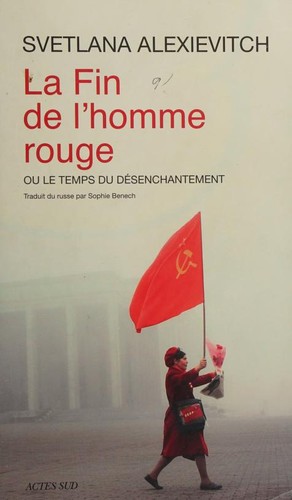
Secondhand Time
Svetlana Alexievich · b. 1948 · Belarus
Originally Vremya Sekond Khend (Russian) · translated by Bela Shayevich
Why it matters
Hundreds of ordinary voices mourn and reckon with the collapse of the Soviet Union. Alexievich's polyphonic 'novel of voices' records the 'red soul' from the people who lived and lost it: a form that won the Nobel.
At a glance
Individually plain-spoken oral testimonies, though the sheer volume of voices requires stamina.
Deep dive
Hundreds of unfiltered voices, recorded across the wreckage of a collapsed empire, argue with each other about what was actually lost when an entire way of understanding a life ran out.
Written for readers who have finished the book. No plot recap, and nothing here is safe to read first.
Themes & symbolism
Alexievich's subject is what she calls "Homo Sovieticus": a psychology formed by seven decades of ideology, scarcity, and collective purpose that didn't evaporate the day the USSR dissolved but persisted as inherited grief, confusion, and, in many mouths, genuine nostalgia — even among people who suffered directly under the system that produced them. The book refuses the tidy liberation narrative (dictatorship bad, markets good) in favor of something far harder to sit with: a population handed no replacement framework for meaning once the old one, however brutal, was taken away, left improvising sense out of Stalinist violence, ethnic war, and sudden poverty with nothing coherent to hold onto.
Form is argument here. By letting dozens of testimonies — Party loyalists, Gulag survivors, young capitalists, bewildered pensioners, witnesses to Caucasus and Central Asian bloodshed — stand largely unmediated and often flatly contradicting each other, Alexievich builds history from the bottom up rather than handing readers a synthesized thesis; the polyphony itself, cited explicitly by the Nobel committee, is the new literary form her prize recognized, blurring oral history, journalism, and the novel into something none of those genres could do alone.
The Documentary Method
Alexievich's interviews, conducted over years across the former Soviet space, are shaped by patient, repeated visits rather than single sit-downs — she has said she returns to subjects until the performed version of their story breaks down into something rawer. The editing is invisible but total: she selects, cuts, and arranges testimony into something with the shape and pressure of fiction while insisting on its documentary status, a tension she calls writing "a history of the soul" rather than of events.
Voices from Big Utopia
Secondhand Time is the closing volume of a five-book cycle Alexievich spent decades assembling, alongside War's Unwomanly Face (women's testimony from World War II), Zinky Boys (the Soviet war in Afghanistan), and Voices from Chernobyl. Read together, the cycle traces a single arc: the Soviet promise of collective utopia, tested by war and catastrophe, finally liquidated by its own collapse — and this last volume is where the survivors are left to account for what the whole experiment cost them personally.
Where to go next
 Svetlana Alexievich · 1997Voices from ChernobylLvl 4Medium pace
 Ludmila Ulitskaya · 2010The Big Green TentLvl 5Medium pace
 Vladimir Sorokin · 2006Day of the OprichnikLvl 5Fast paced
 Viktor Pelevin · 1992Omon RaLvl 5Fast paced
 Antonio Tabucchi · 1994Pereira MaintainsLvl 4Medium pace
 Sergei Dovlatov · 1986The SuitcaseLvl 3Fast paced