
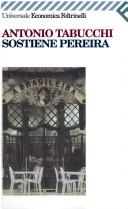
Pereira Maintains
Antonio Tabucchi · 1943–2012 · Italy
Originally Sostiene Pereira (Italian) · translated by Patrick Creagh
Why it matters
An aging, apolitical Lisbon journalist under Salazar's dictatorship is slowly radicalized by a young writer he takes under his wing. Quiet moral awakening rendered in exquisitely restrained, deposition-like prose.
At a glance
Clear, deposition-like repetition ('Pereira maintains') carries a simple surface.
Deep dive
An aging Lisbon editor who has spent his career avoiding politics starts ghostwriting obituaries for living men, and the young writer he hires to help pulls him somewhere he never meant to go.
Written for readers who have finished the book. No plot recap, and nothing here is safe to read first.
Themes & symbolism
Every sentence of Pereira's story arrives filtered through the same reporting tag, 'Pereira maintains,' a device that turns the entire novel into something closer to a deposition than a narration: someone, unnamed, is taking Pereira's account down after the fact, which means the reader spends the book unsure whether they are watching events happen or watching an old man's careful, after-the-fact account of his own quiet defiance. Tabucchi never explains who is listening, and the ambiguity does real work, since the device that would normally distance a reader from a character instead makes his testimony feel urgently, legally consequential.
Pereira hires Monteiro Rossi, a broke, politically committed young man, to write advance obituaries of prominent cultural figures for the paper's culture page, and Rossi keeps turning in pieces so bluntly anti-fascist they're unpublishable under Salazar's censors, forcing Pereira to pay him out of his own pocket for work he can't print. The arrangement, absurd on its face, an editor bankrolling essays he'll never run, becomes the novel's real plot: Rossi's recklessness keeps handing Pereira evidence of the dictatorship's cruelty that his professional caution has spent a lifetime not looking at directly.
Dr. Cardoso, a doctor Pereira consults for his heart condition, introduces him to a theory of the self borrowed from Fernando Pessoa: that a person is not one fixed soul but a 'confederation of souls,' a hegemonic self that can, under pressure, be displaced by another self more capable of action. Tabucchi, Pessoa's own translator in life, uses Cardoso's theory as the book's explicit account of how Pereira changes, not through argument but through one self quietly ceding control to another.
Salazar's Portugal Behind a Pen Name
Tabucchi set the novel in 1938, deep in António de Oliveira Salazar's Estado Novo, when censorship made even a culture page a site of risk, and wrote it in six weeks in 1993 explicitly as a warning aimed at Silvio Berlusconi's Italy, a country he saw sliding toward the same complacent, entertainment-first authoritarianism. The novel became required reading in Italian schools and a rallying cry against Berlusconi almost immediately, an unusually direct afterlife for a book that argues, at its center, for the danger of political silence.
The last seal: what actually happens, and why it lands the way it does.
The ending, explained
PIDE agents track Rossi to Pereira's own apartment, where he's been hiding, and beat him to death while Pereira is out; when Pereira returns to find the body, the caution that has organized his entire life gives way at last. He writes Rossi's death up as a bald front-page report naming the secret police, tricks the paper's government-appointed censor into approving it by presenting it as an obituary, gets it into print before anyone can stop him, and leaves Lisbon by train that same night for the French border. Tabucchi ends the novel mid-flight rather than on any confirmation Pereira makes it out, the act of publishing standing in for whatever safety might or might not follow it.
Where to go next
 Elena Ferrante · 2011My Brilliant FriendLvl 3Fast paced
 Jenny Erpenbeck · 2015Go, Went, GoneLvl 5Medium pace
 Fernando Pessoa · 1982The Book of DisquietLvl 7Slow burn
 Cees Nooteboom · 1980RitualsLvl 6Slow burn
 Italo Calvino · 1972Invisible CitiesLvl 5Slow burn
 Alberto Moravia · 1951The ConformistLvl 5Medium pace