
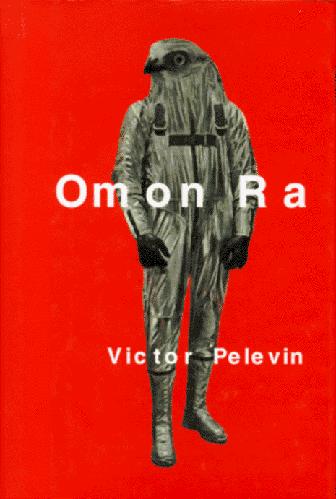
Omon Ra
Viktor Pelevin · b. 1962 · Russia
Originally Omon Ra (Russian)
Why it matters
A young Soviet cadet trains obsessively for a heroic one-way mission to the moon, only to find the cosmodrome's grandeur curdling into something stranger and far more sinister. Ideology's collapse played as absurdist tragedy by post-Soviet Russia's most elusive novelist.
At a glance
A brisk, linear plot carries the difficulty of decoding its layered ideological satire.
Deep dive
A Soviet cadet trains his whole short life for a heroic one-way trip to the moon, and the closer the mission gets, the less certain it becomes that any of it is happening where he thinks it is.
Written for readers who have finished the book. No plot recap, and nothing here is safe to read first.
Themes & symbolism
Omon Krivomazov names himself after the elite Soviet police unit as a boy and grows up wanting nothing except to become a cosmonaut, so when he's accepted into a training program for a secret lunar mission he reads it as the fulfillment of a lifelong ambition rather than what it actually is: a program built entirely around Soviet mythology's most treasured story of self-sacrifice. His flight school is modeled obsessively on the legend of Alexei Maresyev, the legless wartime pilot who returned to combat flying, and cadets are made to practice on prosthetics and treat disability as a badge of honor to be earned rather than a condition to be endured, a grotesque literalization of a propaganda story that Pelevin treats as barely exaggerated at all.
The mission itself, Omon eventually discovers, is not a spaceflight but an elaborate physical performance staged in tunnels beneath Moscow, the 'lunar surface' a hollowed-out section of the metro system, the broadcast footage of Soviet triumph in space faked from below ground by men who are then expected to die quietly to preserve the illusion. Pelevin's satire lands less on the fabrication itself than on how completely Omon has internalized the mission's mythology before he learns the truth: he has spent his whole life training to want exactly the death the state is asking of him, and the novel's real subject is how thoroughly a closed ideological system can manufacture its own believers' desires before it ever has to force anything on them.
Maresyev's Cult, Turned Literal
Alexei Maresyev, a real Soviet fighter pilot who lost both legs to frostbite after a 1942 crash and returned to flying on prosthetics, became one of the Soviet Union's most heavily propagandized heroes, the subject of a bestselling novel and a required example of ideological willpower overcoming physical limitation. Pelevin's flight school takes that officially sanctioned legend and makes it into literal training doctrine, cadets pushed toward disability as proof of commitment, a satire so close to the real cult of Maresyev that it barely needs to exaggerate to become horrifying.
The last seal: what actually happens, and why it lands the way it does.
The ending, explained
Omon eventually realizes that even his own planned death, meant to complete the illusion of a successful one-way landing, has been anticipated and staged by his superiors down to a body double waiting to take his place, and in the tunnels beneath the city he manages to slip away from his handlers rather than complete the mission as scripted. The novel ends with him surfacing into the real Moscow metro, an ordinary, crowded, indifferent public space, and simply walking off among commuters who have no idea what he has just come from or what he was supposed to become. Pelevin refuses him any triumphant unmasking of the state's lie. Omon's survival is anticlimactic on purpose: after an entire life built around a manufactured heroic death, the only actual freedom available to him is to disappear into the crowd and mean nothing at all.
Where to go next
 Viktor Pelevin · 1996Buddha's Little FingerLvl 7Medium pace
 Vladimir Sorokin · 2006Day of the OprichnikLvl 5Fast paced
 Georgi Gospodinov · 2020Time ShelterLvl 6Medium pace
 Ludmila Ulitskaya · 2010The Big Green TentLvl 5Medium pace
 Mircea Cărtărescu · 1989NostalgiaLvl 8Slow burn
 Péter Esterházy · 2000Celestial HarmoniesLvl 8Slow burn