
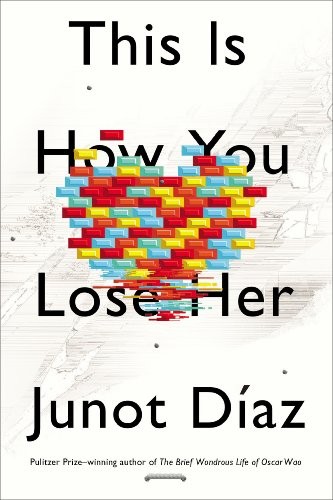
This Is How You Lose Her
Junot Díaz · b. 1968 · Dominican Republic / United States
Why it matters
Linked stories follow Yunior, serial cheater and Dominican-American striver, across decades of love affairs he keeps sabotaging. Díaz's Pulitzer-finalist collection extends Oscar Wao's voice into unsparing self-portraiture.
At a glance
Code-switching, slang-dense prose demands the same acclimation as Oscar Wao.
Deep dive
Yunior narrates nearly every story in this Dominican-American collection, from his brother's cancer to his own serial infidelities, and the final piece finally turns the accusation on himself.
Written for readers who have finished the book. No plot recap, and nothing here is safe to read first.
Themes & symbolism
Yunior narrates every story here but one, tracking his family's infidelities across three generations: his father Ramon keeps a second, secret household in New Jersey for years before the family in Santo Domingo even immigrates; his older brother Rafa cycles through girlfriends with the same appetite even as cancer visibly wastes him; and Yunior spends the whole book insisting he's different while repeating exactly the same pattern with Magda, then Alma, then the fiancee he loses in the closing novella. Diaz builds the repetition into the book's real argument, infidelity here is not a series of isolated betrayals but something closer to an inheritance Yunior can name in his father and his brother for two hundred pages before he can admit it in himself.
The one story with a different narrator, Otravida, Otravez, hands the book to Yasmin, a laundry worker at a New Jersey hospital and the other woman in Ramon's secret second household, and the choice matters more than a change of voice: for one story, the book lets someone Yunior's family has only ever discussed as a betrayal narrate her own actual life, waiting on a man who keeps deferring the promises he's made her.
Miss Lora and Invierno bracket the family timeline at its two hardest points. Invierno reaches back to the Diaz family's first Jersey winter after emigrating, Yunior and Rafa confined to a cold apartment while Ramon runs the household with the same controlling absence he'll later bring to his second family, a domestic dress rehearsal for the infidelity the grown men repeat. Miss Lora moves forward instead, to a sixteen-year-old Yunior grieving Rafa's death from cancer and drifting into a monthslong affair with an older neighbor the block treats as one more small-town scandal rather than the exploitation it plainly is, Diaz declining to let grief excuse what either of them does with it.
Ramon's Second Family as the Book's Original Sin
Every son in this book inherits some version of Ramon's double life, Rafa by repeating it openly, Yunior by insisting he's above it while doing exactly the same thing more quietly, and Diaz treats the father's affair less as backstory than as the mechanism the rest of the collection keeps testing on a new generation.
Second Person as Sentence in The Cheater's Guide to Love
Addressing Yunior as you for the entire closing novella turns five years of his own decline into an indictment he can't dodge by narrating it in the third person, the way he's dodged responsibility all book, the grammar itself refusing him the usual distance between a man and the damage he's caused.
The last seal: what actually happens, and why it lands the way it does.
The ending, explained
Yunior's fiancee finds a notebook in which he has, almost compulsively, kept a list of the roughly fifty women he cheated with during their engagement, and The Cheater's Guide to Love spends five years tracking what happens after she leaves him for good: the drinking, the halfhearted rebound relationships, a prediabetes diagnosis that briefly threatens to replace one form of self-destruction with another. The novella's final movement finds Yunior, older and alone, going back through old photographs and journals from the relationship he ruined, and beginning, tentatively, to write, an act the book leaves ambiguous between therapy and evasion but that closes the loop the whole collection has been building toward: the man who spent nine stories describing what other men did to women he loved finally puts his own failures into the same sentence.
Where to go next
 Junot Díaz · 2007The Brief Wondrous Life of Oscar WaoLvl 7Fast paced
 Adam Johnson · 2012The Orphan Master's SonLvl 6Fast paced
 Jeffrey Eugenides · 2002MiddlesexLvl 6Medium pace
 Jonathan Franzen · 2001The CorrectionsLvl 6Medium pace
 Jhumpa Lahiri · 1999Interpreter of MaladiesLvl 3Medium pace
 Juan Rulfo · 1955Pedro PáramoLvl 7Slow burn