
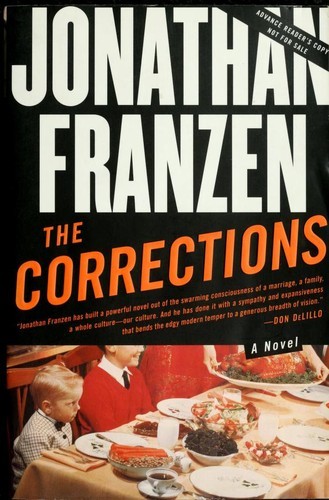
The Corrections
Jonathan Franzen · b. 1959 · United States
Why it matters
A Midwestern family's last Christmas together becomes a panoramic reckoning with capitalism, psychiatry, and generational disappointment. Widely credited with reviving the big American family novel.
At a glance
Long digressive sentences and shifting close-third perspectives across a large family.
Deep dive
What the title's 'corrections' actually turn out to be once you notice how small and how late they arrive for every Lambert.
Written for readers who have finished the book. No plot recap, and nothing here is safe to read first.
Themes & symbolism
The title works on at least three registers at once: Alfred's career at the railroad turned on literal metal corrections to track geometry; Enid and the children spend the novel trying to correct each other's careers, marriages, and medications; and the era's stock-market 'correction' supplies the backdrop of an economy that, like the Lamberts, is overdue for a reckoning it keeps deferring. Franzen's real subject is how badly 'correction' overpromises — every character believes some adjustment, chemical, financial, or romantic, will fix what's actually a structural, decades-deep family failure, and every fix turns out partial at best.
Alfred's Parkinson's, with its tremors and hallucinated turds delivering him lectures, literalizes what's already true of him emotionally: a rigid, withholding patriarch whose body now betrays the same self-control that organized his whole personality, so his disintegration reads as psychology finally catching up with physiology. Franzen sets the children's very different escapes from that household, Gary's suburban money and resentment, Chip's flight into academic disgrace and a scheme in post-Soviet Lithuania, Denise's affairs and restaurant ambition, as three separate rebuttals of Alfred and Enid's Midwestern discipline, none of which actually frees anyone from it.
Correcting the Family Novel Itself
Franzen wrote The Corrections partly as a rebuttal to his own earlier, more maximalist 'systems novels,' scaling down to a single family in order to smuggle the same social-critique ambitions, psychiatry, agribusiness, cruise-ship consumerism, post-Soviet capitalism, into a form readers actually wanted to finish. The gambit's success, a National Book Award, a famous public spat with Oprah's Book Club, and lasting credit for reviving the big American family novel after decades of minimalism, is itself a small irony the book seems to have anticipated: a novel about the impossibility of truly correcting anything became the correction American fiction was apparently waiting for.
Chip's Lithuania and the Novel's Widest Lens
The detour into Chip's involvement with a fraudulent Lithuanian investment scheme, run by his girlfriend's ex, is the novel's boldest structural risk, a comic set piece about post-Soviet chaos that seems, for a hundred pages, to have wandered away from the family plot entirely. It's really Franzen widening the aperture on the argument the Lamberts are living domestically: that the promise of correction, personal or economic, sells hardest exactly where the underlying system is least fixable.
The last seal: what actually happens, and why it lands the way it does.
The ending, explained
The family's last Christmas together in St. Jude brings a fragile, partial thaw rather than any real resolution — old grievances resurface, but everyone shows up, which the novel treats as its own modest achievement. Alfred's decline continues past the holiday; his Parkinson's and dementia worsen until he dies in a nursing home, his body finally delivering the correction his will could never make. Enid, freed after decades of caretaking and a marriage organized entirely around Alfred's rigidity, discovers to her own surprise that she can imagine changing her life — small adjustments, undertaken late, that the novel presents without irony as the only kind of correction actually available to anyone. It's a deliberately unglamorous ending for a book that spent five hundred pages distrusting bigger ones.
Where to go next
 Jonathan Franzen · 2010FreedomLvl 5Medium pace
 Jeffrey Eugenides · 2002MiddlesexLvl 6Medium pace
 Junot Díaz · 2007The Brief Wondrous Life of Oscar WaoLvl 7Fast paced
 Jokha Alharthi · 2010Celestial BodiesLvl 7Slow burn
 Percival Everett · 2001ErasureLvl 6Fast paced
 Alice McDermott · 1998Charming BillyLvl 5Slow burn