
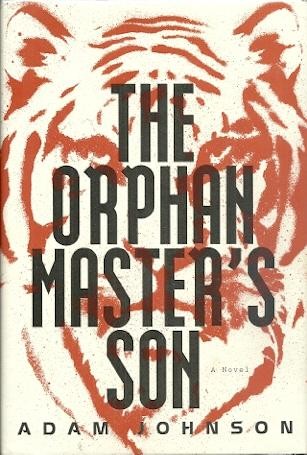
The Orphan Master's Son
Adam Johnson · b. 1967 · USA
Why it matters
A North Korean state orphan is reassigned in turn to kidnapping missions, propaganda broadcasts, and finally the stolen identity of a Party official, in a regime rendered from meticulous outside research. Johnson's Pulitzer winner treats totalitarian horror as espionage plot and black comedy at once.
At a glance
Shifting narrators and propaganda-interrupted structure across a hard-to-verify totalitarian setting demand close attention.
Deep dive
How a state that trains children to be orphans ends up training a man to disappear into someone else's life, and what happens when the propaganda machine writes the ending anyway.
Written for readers who have finished the book. No plot recap, and nothing here is safe to read first.
Themes & symbolism
Johnson's premise turns North Korea's cult of the state-as-parent into the novel's engine: Jun Do, raised in an orphanage though he insists — unconvincingly, tellingly — that he isn't actually an orphan, spends the book being reassigned from role to role (kidnapper, radio interceptor, propaganda functionary, and finally the stolen identity of Commander Ga) because a state that claims to parent everyone treats individual biography as infinitely rewritable. Identity here isn't something a person has, it's something the Party issues and can reissue, and Jun Do's willingness to keep accepting new names is less character flaw than survival adaptation to a system where having a fixed self is dangerous.
Sun Moon, the actress married to the real Commander Ga, functions as the regime's ultimate manufactured object — her beauty and her films exist to be watched and interpreted as propaganda regardless of what she actually feels, which is exactly the position Jun Do finds himself in once he takes her husband's identity and, improbably, begins to genuinely love her. The recurring loudspeaker broadcasts that narrate an idealized version of daily life over every scene are the novel's most literal symbol: an official story running continuously on top of the actual one, and the gap between the two — audible to the reader, invisible within the fiction to everyone required to nod along — is where the book's black comedy and its horror both live.
Three Competing Narrators
Johnson tells the story through three interleaved registers — a close third-person narrative following Jun Do, transcripts of his interrogation by a state investigator convinced there's a coherent truth to extract, and excerpts from the state's own loudspeaker propaganda broadcasting a version of these same events. None of the three fully agrees with the others, and the novel never adjudicates between them; instead it dramatizes, formally, its own thesis — that in a totalitarian state, competing official narratives don't cancel each other out, they simply coexist, each equally binding on the people who have to live inside them.
The last seal: what actually happens, and why it lands the way it does.
The ending, explained
Captured and subjected to brutal state interrogation once his stolen identity as Commander Ga unravels, Jun Do uses his final maneuvering room to engineer Sun Moon and her two children's escape from North Korea rather than save himself. He is executed. The state's propaganda apparatus immediately gets to work fabricating an official account of what happened to him — one that serves the Party's narrative needs and bears little relation to the facts the novel has spent four hundred pages establishing. That fabrication is the book's final and bleakest point: individual sacrifice and even individual truth are essentially irrelevant to a regime that will simply write the story it needs regardless of what actually occurred, leaving Jun Do's real act of love legible only to the reader, not to history.
Where to go next
 Adam Johnson · 2015Fortune SmilesLvl 5Medium pace
 Junot Díaz · 2007The Brief Wondrous Life of Oscar WaoLvl 7Fast paced
 George Orwell · 1949Nineteen Eighty-FourLvl 4Fast paced
 Paul Harding · 2009TinkersLvl 6Slow burn
 Jeffrey Eugenides · 2002MiddlesexLvl 6Medium pace
 Jonathan Franzen · 2001The CorrectionsLvl 6Medium pace