
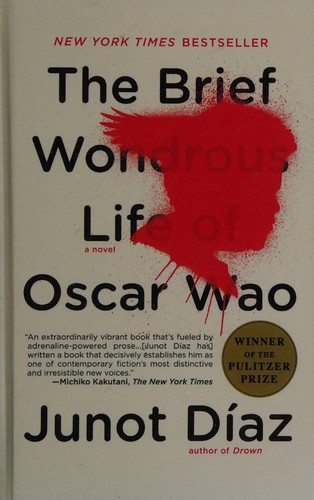
The Brief Wondrous Life of Oscar Wao
Junot Díaz · b. 1968 · Dominican Republic / United States
Why it matters
A nerdy, unlucky Dominican-American boy is cursed by his family's history under the Trujillo dictatorship. Comic-book energy, footnotes, and Spanglish carry real historical weight in this Pulitzer winner.
At a glance
Dense footnotes, Spanglish code-switching, and genre-hopping digressions.
Deep dive
Why Yunior insists Oscar's brief, unlucky life amounts to a victory over the fukú that's supposedly cursed his family since Trujillo, no matter how the odds were stacked against him.
Written for readers who have finished the book. No plot recap, and nothing here is safe to read first.
Themes & symbolism
Fukú americanus — the curse Díaz's opening pages trace back to Columbus and lodge specifically in the Trujillo dictatorship — gives the novel its founding conceit: history in the Dominican Republic isn't background, it's an active, malevolent agent that ruins bodies across generations, from Oscar's grandfather's imprisonment and torture under Trujillo to his mother Beli's brutal beating in a cane field decades before Oscar dies in one himself. Genre fiction is Oscar's inherited coping language for a trauma too large for realism — Tolkien, Akira, and superhero mythology give him a vocabulary his family's actual history has no room to speak in Spanish or English, and Díaz's own prose, stuffed with untranslated Spanish and nerd-culture footnotes, performs the same bilingual, code-switching survival.
Dominican machismo is the curse's most intimate delivery system, and Oscar's failure to perform it — fat, virginal, guileless in a culture that prizes conquest — is precisely what makes him legible as its ultimate casualty and, in Yunior's telling, its final challenger. Yunior himself, a serial womanizer narrating with real tenderness and real self-implication, is never let off the hook: his own inherited machismo makes him part of the same system that kills Oscar, and his decision to write the book at all is explicitly framed as a zafa, a counter-spell, an act of love aimed at breaking the curse rather than merely recording it.
The Footnotes as Counter-History
Díaz runs a second, scholarly-voiced narrative in footnotes beneath the fiction, cramming in the actual atrocities of the Trujillato — assassinations, disappearances, the dictator's personal cruelties — material a reader raised on genre fiction rather than Caribbean history would otherwise have no access to. The footnotes are a formal argument as much as an information dump: official Dominican history sits marginalized, literally beneath the main text, requiring translation and annotation for an American audience the way Oscar's own geek vocabulary requires translation for everyone around him.
Yunior's Unreliable Devotion
Yunior insists he is unqualified to tell Oscar's story and tells it anyway, at enormous length, years after the fact and partly out of guilt over failing Oscar's sister Lola. His voice colonizes the narrative he claims to be preserving — slangy, digressive, self-mythologizing — so that the book becomes as much a portrait of Yunior's own moral reckoning as of Oscar's life, a narrator working out his fitness to love by proving he can finally tell someone else's story straight.
The last seal: what actually happens, and why it lands the way it does.
The ending, explained
After a lifetime as an unlucky, love-starved outcast, Oscar finally finds requited passion with Ybón, a Dominican sex worker involved with a corrupt police captain, and refuses to walk away even after a first beating warns him off. He returns to her anyway, is taken to a cane field by the captain's men, and is beaten and shot to death — but not before, he reports in a final letter, sleeping with Ybón and hearing her say she loves him. Yunior frames the murder not as fukú's triumph but as Oscar's: cursed his whole life to die a virgin and unloved, he instead dies having gotten, however briefly, the one thing the curse was designed to withhold, which is why Yunior can call the wondrous, brief life a kind of victory rather than only a waste.
Where to go next
 Junot Díaz · 2012This Is How You Lose HerLvl 5Fast paced
 Adam Johnson · 2012The Orphan Master's SonLvl 6Fast paced
 Jeffrey Eugenides · 2002MiddlesexLvl 6Medium pace
 Jonathan Franzen · 2001The CorrectionsLvl 6Medium pace
 Jhumpa Lahiri · 1999Interpreter of MaladiesLvl 3Medium pace
 Juan Rulfo · 1955Pedro PáramoLvl 7Slow burn