
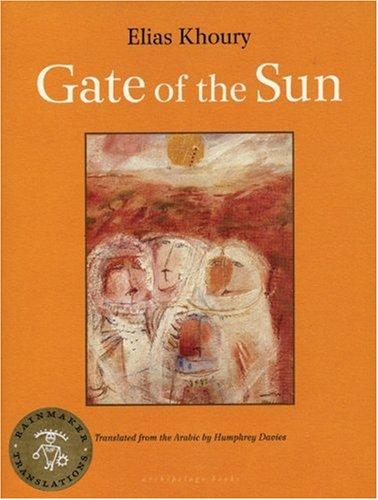
Gate of the Sun
Elias Khoury · 1948–2024 · Lebanon
Originally Bab al-Shams (Arabic) · translated by Humphrey Davies
Why it matters
A dying man's bedside storytelling gathers decades of Palestinian dispossession, the 1948 Nakba, and refugee camp life into one polyphonic testimony. Built from years of collected oral history, a monument to Palestinian memory.
At a glance
Polyphonic, nonlinear oral testimonies interweave hundreds of voices across decades.
Deep dive
A nurse in a falling-apart Beirut refugee camp clinic talks for hundreds of pages to a patient who cannot answer, and the story he is actually trying to keep alive is not just one man's.
Written for readers who have finished the book. No plot recap, and nothing here is safe to read first.
Themes & symbolism
Khalil's monologue to the comatose Yunes is an explicit descendant of Shahrazad's bargain, storytelling deployed as a technology for keeping someone, possibly himself as much as his patient, alive. Khoury built the novel from years spent recording the oral testimonies of actual Palestinian refugees in the Shatila camp, and that method shows in how Yunes's biography keeps absorbing details that feel borrowed, composite, argued over by different tellers, because the novel's real claim is that Palestinian history now exists this way: as competing, overlapping testimony rather than a single authorized account.
At the center of that testimony is Yunes and Nahilah's marriage, sustained for decades through clandestine meetings at a cave the lovers name Bab al-Shams, the Gate of the Sun, on the border the 1948 war drew between them. A marriage conducted entirely in stolen border crossings becomes the novel's clearest image of what exile does to intimacy: love that is never allowed to become a home, only a series of returns to a threshold neither party is permitted to fully cross.
Khoury refuses the 1982 massacre at Sabra and Shatila, which sits at the novel's historical center, a single settled account either. Different characters remember the same nights differently, contradict each other's chronology, argue about who did what and when, and the book declines to referee between them. That refusal to flatten multiplicity into one official story is presented as the only honest response to a history the outside world keeps trying to summarize in a sentence.
A Novel Assembled From Other People's Memories
Khoury spent years interviewing residents of the Shatila camp before writing Gate of the Sun, and the novel's texture carries that method openly: digressions, contradictions, and competing versions of the same event are left standing rather than smoothed into a single narrative line. Reading the book as one man's account of one other man's life misses what it is actually doing, which is trying to give a collective, contested history a form that does not falsify it by making it tidy.
Village Names That No Longer Exist
Yunes's memories keep returning to villages, al-Kweikat, al-Birwa, Ain al-Zaitoun, that were emptied and in most cases physically demolished during and after 1948, and Khoury refuses to let them function as simple backdrop. He has Khalil and Yunes name them again and again, insisting on their specific geography, their wells and orchards and family names, against a history that has largely erased them from any map still in print. The repetition is itself a form of resistance: a village kept alive in speech even after it has stopped existing on the ground.
The last seal: what actually happens, and why it lands the way it does.
The ending, explained
Khoury never confirms whether Yunes wakes from his coma or dies in it, and the novel's closing pages leave that question exactly as open as everything else Khalil has spent the book narrating. What does resolve is Khalil's own position: having spoken Yunes's life aloud for so long, filling in silences and disputed details with his own inventions, he has effectively become a teller of the kind Yunes himself once was, carrying the older man's story, and the responsibility of carrying it honestly, forward into whatever comes after the hospital doors.
Where to go next
 Elias Khoury · 1977Little MountainLvl 7Slow burn
 Alaa Al Aswany · 2002The Yacoubian BuildingLvl 4Fast paced
 Abdul Rahman Munif · 1984Cities of SaltLvl 6Slow burn
 Naguib Mahfouz · 1956Palace WalkLvl 4Medium pace
 Jokha Alharthi · 2010Celestial BodiesLvl 7Slow burn
 Amos Oz · 2002A Tale of Love and DarknessLvl 6Slow burn